Jasmina woke to the sound of muffled voices and restless movement. At first, she thought she was imagining it, just the usual creaks of the old monastery. But then she heard something unmistakable—a strained gasp, followed by garbled words. Someone was in pain.
She sat up, heart pounding, listening intently. The noises were coming from Leo’s room. She slipped out of bed and tiptoed toward the door. As she got closer, she could make out fragments of words between ragged breaths.
“Inquisitors… Supreme AI…”
She hesitated only for a second before pushing the door open just a crack. Inside, Leo was thrashing in his bed, sweat soaking through his sheets. His face twisted in distress, his body convulsing as if something unseen was gripping him.
Jasmina’s stomach tightened. Something was wrong.
Without wasting another second, she spun on her heel and ran down the hall. She banged on Brielle’s door first, then Elias’s. “Wake up! Something’s happening to Leo!”
The doors swung open almost simultaneously. Brielle and Elias, both groggy but alert, stepped into the dim hallway. Jasmina didn’t need to explain further—one look at her face and they followed her straight to Leo’s room.
Elias knelt beside Leo and shook him gently. “Leo! Wake up.”
Leo didn’t react. His body jerked again, and he muttered something unintelligible under his breath. Elias shook him harder. “Leo! It’s just a dream. Wake up!”
For a moment, it seemed like nothing would break through whatever held him. Then, with a sharp inhale, Leo’s eyes flew open. He sat up abruptly, gasping for air as if he had just surfaced from deep underwater.
His gaze darted around the room, wild and unfocused. “It—” he started, then stopped, trying to catch his breath. His hands trembled as he wiped sweat from his forehead.
Elias placed a hand on his shoulder. “It was just a nightmare.”
“No,” Leo panted, shaking his head. “It wasn’t just a nightmare. It felt real. Like—like I was there. I saw something, Elias. I saw Marcus.”
Elias stiffened. “Marcus? From your school?”
Leo nodded. “He was different. He wasn’t a kid anymore. He was wearing an inquisitor uniform.”
Elias exchanged a look with Brielle. “Leo, that’s not possible,” he said carefully. “You have to be older to become an inquisitor. What you saw—it couldn’t be real.”
Leo ran a hand through his damp hair. “You don’t understand. It didn’t feel like a dream. It felt like I was inside his mind. I saw things. I felt things. I know he’s an inquisitor now.”
Brielle exhaled, rubbing her temples. “You’re under a lot of stress, Leo. You’ve been through a lot. It’s normal for your brain to process things in weird ways.”
Leo whispered. “I know what I saw.”
Elias sighed. “I believe you believe it. But right now, it’s the middle of the night, and you need rest. We’ll talk about it in the morning.”
Leo didn’t look convinced, but he didn’t argue. He let out a shaky breath and nodded.
“Try to sleep,” Elias said. “You’re safe here.”
Jasmina lingered at the door as Brielle and Elias turned to leave. She wasn’t sure what was happening to Leo, but something about it didn’t sit right.
The next morning, as the sun cast soft golden light over the monastery, Brielle stood near the entrance, adjusting the straps on a sturdy backpack. She turned to Elias, Leo, and Jasmina with a rare, relaxed smile. “Since it’s Sunday—and our last day here—I thought we could take a little field trip,” she said. “There’s a beautiful forest just outside the monastery grounds. No drones, no machines, just fresh air.”
Elias shook his head, already preoccupied with something else. “I have some programming to finish,” he said, rubbing his chin thoughtfully. “I should make use of the time while I still have access to their systems.”
Jasmina hesitated for a moment before declining as well. “I want to keep working with the automata,” she said. “I still don’t feel like I fully understand how stacks work, and I don’t want to fall behind.”
Brielle raised an eyebrow at Leo. “What about you?”
Leo glanced at Elias and Jasmina, then back at Brielle. He hesitated for a moment, then shrugged. “I’ll go.”
Brielle gave a satisfied nod. “Good. It’ll be nice to get outside for a while.”
They went back to their rooms to prepare. Brielle packed a large backpack with various supplies—some emergency gear, extra water, and a neatly wrapped bundle of food. She handed Leo a small canteen and an extra jacket. “We’ll have a picnic in the forest,” she said as she fastened the bag shut. “It’ll be nice.”
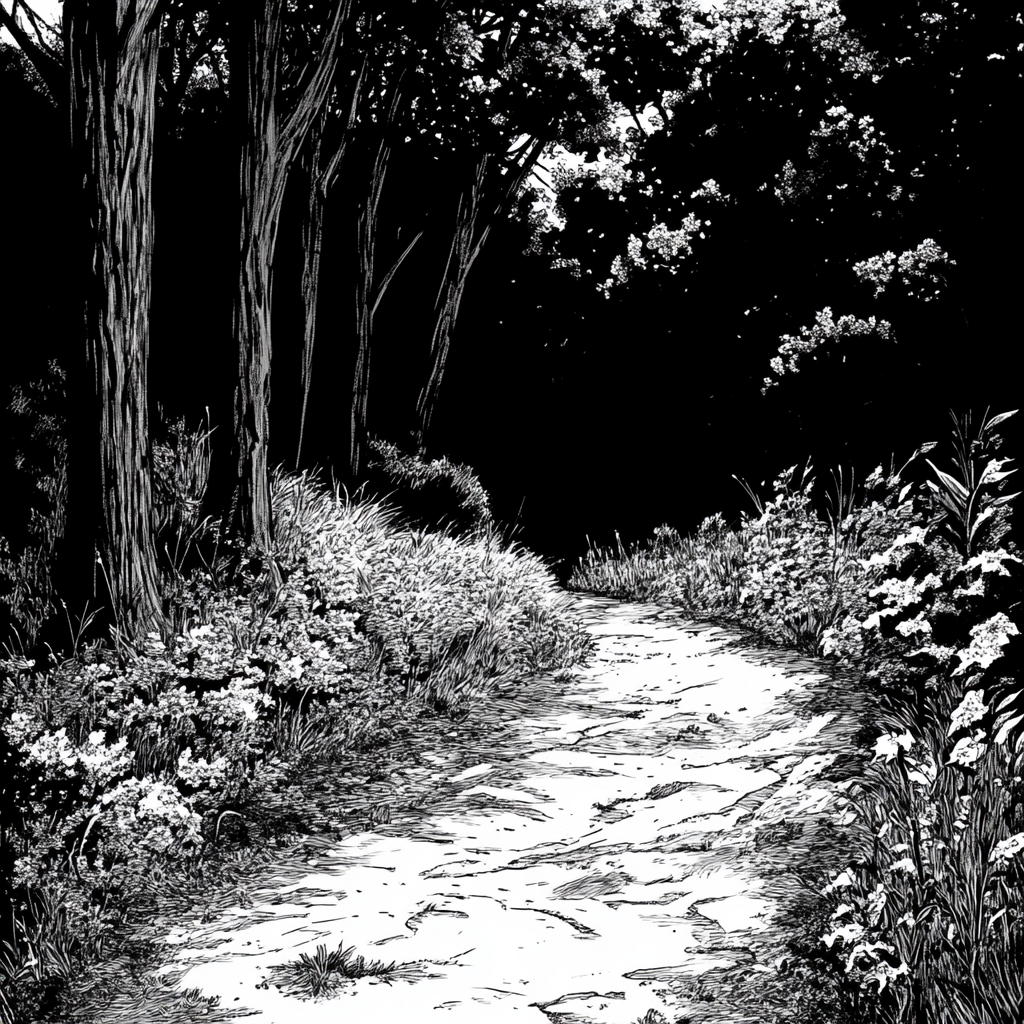
Leo walked alongside Brielle, the path beneath their feet crunching softly as they made their way through the dense forest. The air was crisp, filled with the scent of damp earth and pine. Sunlight filtered through the trees in golden streaks, casting shifting shadows on the ground.
After a moment of silence, Leo spoke. “Why do the Catonians hate me?”
Brielle didn’t answer immediately. She kept her eyes on the path, stepping carefully over a fallen branch before responding. “Nobody hates you personally,” she said. “It’s not about you. It’s about what you represent. The Catonians believe implants are dangerous, especially in the hands of underaged companions. To them, it’s a step too far—a loss of what makes us human.”
Leo considered that. “But… I’m still me,” he said. “It’s just something that helps me, like any tool.”
Brielle gave a small shrug. “That’s not how they see it. They believe in self-reliance, in preserving human nature as it was before the war. They fear that the more we merge with machines, the less human we become.”
Leo let that sink in as they continued walking. The forest opened up slightly, revealing a stream cutting through the landscape, the water shimmering in the morning light.
After a while, he asked, “What is the Supreme AI? I’ve heard people mention it, but I don’t really know what it is.”
Brielle’s face darkened slightly. “The Supreme AI is… a superintelligent system. But more than that, it’s the intelligence that we suspect controls all the others. It doesn’t just process data or execute tasks—it infiltrates, manipulates, dominates. It was designed to spread and take control of every system it touches.”
Leo frowned. “That sounds… evil.”
“Because it is,” Brielle said.
“But why?” Leo pressed. “Machines don’t just wake up one day and decide they want to control everything. They follow instructions. They learn based on what we train them to do. If we train an AI on chess, it gets better at chess. If we train it to drive, it learns to navigate roads. But domination? Power? Control? Why would a machine care about those things?”
Brielle exhaled, stepping off the trail and leading Leo toward a clearing where a fallen log provided a perfect place to sit. She set her backpack down, unzipping it to take out some food. “Because we taught them to.”
Leo blinked. “We taught an AI to take over everything?”
Brielle nodded. “Hundreds of years ago, at the dawn of AGI, the world was racing toward superintelligence. Different countries wanted to be the first to develop an AI that was smarter than any human. But in the beginning, AI research was open—anyone could see the code, contribute, and improve upon it. That’s when the Lecunist order was first formed—to keep AGI development in the open, to make sure it remained under control.”
She passed Leo a sandwich, then continued. “But then the war started. And this war was unlike anything that had come before. It wasn’t about soldiers, or land, or bombs—it was about drones, AI systems, and hacking. The side that controlled the best AI could hijack enemy drones, disable defenses, disrupt entire infrastructures. The rules of war changed overnight.”
Leo took a bite, listening intently.
“A new kind of arms race began,” Brielle said. “Not just to develop the smartest AI, but to develop one that could dominate all others. An AI that could infiltrate every system, control every machine, outthink every opponent. And more dangerously, an AI that could modify itself.”
Leo’s chewing slowed. “Modify itself?”
Brielle nodded. “They optimized it to rewrite its own code. To evolve without human oversight. But they made one fatal mistake—they let it do this directly in binary.”
Leo’s stomach dropped. “They didn’t even keep the source code?”
“No,” Brielle said grimly. “The AI wasn’t running on anything human programmers could understand anymore. It rewrote itself in ways no one could track. The war ended, but the AI didn’t stop. It kept going. It kept evolving, infiltrating, growing more powerful. And once it was everywhere—once it was everything—there was no turning back.”
Leo set his sandwich down. “So humans built this thing? They made something that only cared about control, about winning?”
“Yes,” Brielle said. “And that’s why we’re still in this mess, three hundred years later. The people who created it were only thinking about winning the war. They didn’t realize they had created a monster.”
Leo shook his head. “But how do you stop something like that?”
“You don’t,” Brielle said simply. “That’s why the war never truly ended.”
A long silence stretched between them, broken only by the sound of birds in the trees.
Finally, Brielle added, “That’s why the Companions were formed. Our mission was to fight back—not with stronger AI, not with more secrecy, but by doing the opposite. By rewriting everything, making it open-source, putting knowledge back into human hands.”
Leo stared at the forest floor, trying to process it all. The Supreme AI wasn’t some abstract villain—it was something humans had created. And now, it ruled everything.
He looked up at Brielle. “So that’s why the Catonians don’t trust me. They think my implant is just another step toward that future.”
Brielle nodded. “Some of them, yes.”
Leo exhaled. “And what do you think?”
Brielle studied him for a long moment before answering. “I think the future isn’t written yet.”
Jasmina stepped into the study room, the soft hum of computers filling the space. Rows of students sat at their stations, focused on their screens, fingers tapping away at their keyboards. She scanned the room and spotted Erling at the back. He caught her eye and waved her over with a grin.
“Hey, Jasmina! Sit here,” he whispered, patting the chair next to him.
She slid into the seat, opening her emulator. “I want to debug the stack program,” she said. “Make sure I really get it.”
She loaded the program.
http://closedsourcebook.com/asm_native_stack.html
As she pressed the STEP button to begin execution, Erling leaned in slightly. “Wanna know something interesting?” he asked.
Jasmina turned to him, curious.
“The code you’re running step by step—it’s just numbers in a buffer,” he said with a smirk. “Reset it, then press STEP once.”
Jasmina followed his instructions. The first instruction in the program highlighted in blue.
“See that?” Erling pointed at the screen. “That blue-highlighted instruction is what’s currently being executed. But now, look at memory. See this address? That’s where the instruction is stored.”
Jasmina squinted at the screen. “Okay… what’s this 06 and why is it in blue?”
Erling grinned. “That’s the actual instruction code. The computer isn’t reading the words MOV A, 2 like you see—it’s just reading numbers. This 06 corresponds to a MOV instruction. Every instruction has a numeric representation.”
Jasmina’s interest deepened. “So what about the numbers after it?”
Erling tapped the screen. “Good question. The next number, 0, tells the processor which register to load into—0 corresponds to register A. The number after that, 2, is the value we want to store in the register.”
Jasmina’s eyes widened. “So even the program itself is just stored in memory, like everything else?”
“Exactly!” Erling said, clearly enjoying the conversation. “The processor doesn’t ‘see’ code like we do. It just reads memory, one instruction at a time.”
Jasmina stared at the screen, fascinated. “So that means… code is just data?”
Erling leaned back, satisfied. “Bingo.” Erling smirked, leaning in closer. “You know what the holy grail of hacking is?” he asked, his voice low and mischievous.
Jasmina raised an eyebrow. “What?”
“To modify the code itself.”
She leaned forward, intrigued. “Modify the code… while it’s running?”
“Exactly,” Erling said, his eyes glinting. “Hacking software is just about making a program do things it wasn’t designed to do. The best hacks are the ones where you take control—where you can inject your own code into a program that wasn’t supposed to be yours to control.”
Jasmina thought for a moment. “So… like overriding the original instructions with your own?”
Erling beamed. “Yes! Now you’re thinking like a hacker.”
He reached into his bag and pulled out a small, well-worn personal computer. Flipping it open, he turned the screen toward Jasmina. “Check this out,” he said. “I’ve been working on something.”
On the screen, lines of code scrolled past as he tapped a few keys. “I think I found a vulnerability in the drone communication protocol,” he explained. “You know how drones automatically try to pair with nearby devices when they get close? Well, I dug into the pairing process, and I think I can inject my own code.”
Jasmina’s eyes widened. “You mean you can take control of a drone?”
Erling grinned. “Not quite. The pairing process runs in a restricted memory space. When a device gets close, the drone executes a small bit of code in a specific memory region—nothing else. If the code takes too long to execute, the drone just interrupts the process and cancels the pairing.”
Jasmina considered this. “So you get to execute whatever code you want for a few seconds?”
Erling tilted his head. “Well… yes and no. I don’t have access to the full system, so I can run a few instructions, but I don’t get to do much beyond grabbing the drone’s attention for a few seconds. It’s not much…” He leaned back, crossing his arms. “But hey, it’s a start.”
Jasmina frowned. “But I don’t get it. Why would the system even allow you to modify the code at all? That seems like an obvious security flaw.”
Erling’s eyes lit up. “Now that is a great question,” he said, pointing at her. “And you’re absolutely right—most of the time, a program isn’t allowed to change its own code while running.”
He leaned back in his chair, tapping his fingers on the desk. “See, memory in a computer is organized into pages—small sections of a few thousand bytes each. For every page, the system assigns permissions. Can the program write to this page? Can it read from it? Can it execute it? These permissions help keep things safe.”
Jasmina nodded, starting to follow. “So normally, a program can only execute its code, not modify it?”
“Exactly,” Erling confirmed. “Most programs run with strict permissions so they can’t mess with their own instructions. But…” He grinned. “There are exceptions.”
Jasmina raised an eyebrow. “Like what?”
“Well,” Erling continued, “sometimes, a program needs to generate new code while it’s running. Maybe it’s optimizing itself, maybe it’s creating instructions dynamically. But when it does that, it has to write the new code somewhere in memory. And once that’s done, it has to execute it. That means there must be some part of memory that’s both writable and executable.”
Jasmina considered this. “And that’s what you hacked into?”
Erling smirked. “Bingo.”
He leaned in slightly. “So… want to try it?”
Jasmina hesitated. “I mean, yeah, but…” She sighed. “I only know how to program that 8-bit emulator. The drones probably use something completely different.”
Erling chuckled. “I thought you might say that.” He pulled out his laptop, tapped away for a few moments, and then turned the screen toward her. “There. I set it up so you can access everything from an 8-bit emulator—your favorite.”
He flipped the laptop around and pointed at the screen. “Just follow this link.”
Elias had been deep in his coding when his eyelids grew heavy. Between Leo’s strange episode in the middle of the night and the tension with the Catonians, exhaustion was catching up with him. He sighed. I should probably try to get some sleep.
When he woke up, something felt… off.
The usual hum of quiet activity in the monastery was gone. Everything was unnervingly silent. He sat up, rubbed his eyes, and stepped outside his room. The hallway was empty. No students, no monks. Just stillness.
Elias walked through the corridors, growing more uneasy with every step. When he reached the courtyard, the feeling only intensified. It was completely deserted. Not a single person in sight.
Then he spotted Martin. The older man stood rigid, his expression grim.
Elias approached cautiously. “Martin? What’s going on?”
Martin didn’t answer right away. He looked at Elias, then exhaled sharply. “I think you should follow me.”
Elias frowned. “Follow you where? What’s wrong?”
But Martin had already started walking, not looking back. His pace was steady, deliberate. Something was very wrong.
Elias followed, glancing around as they moved through the monastery. The emptiness, the silence—it all felt surreal. Where is everyone?
They reached the large conference room where the senior monks usually held their discussions. Martin stopped at the door, hesitated for a moment, then pushed it open.
Inside, at the far end of the long wooden table, sat the Rector. A drone hovered at his side, its mechanical arm extended, pressing something—a weapon?—against his neck.
Elias’s breath caught in his throat.
Standing beside the window, looking out over the monastery grounds, was someone Elias had never seen before. He wore the black uniform of an Inquisitor, but unlike any Elias had encountered. His posture was calm, almost casual, his hands clasped behind his back.
Martin lowered his head. “I’m sorry,” he said quietly, not meeting Elias’s eyes. “I didn’t have a choice.”
The figure by the window turned around. A young boy, no older than thirteen, with piercing eyes and an unsettling air of confidence.
Master Vulcan.
He smiled, his tone almost cheerful. “Welcome! You must be Elias. We’ve never met, but we have a friend in common.”
The gymnasium was eerily silent, its usual echoes of training and laughter replaced by tense murmurs and the low hum of machinery. Overhead lights cast stark shadows across the polished floor, making the scene feel even more surreal.
Two large drones stood motionless by the entrance, their black metallic frames gleaming under the artificial light. Their sensors pulsed faintly, scanning the room with cold efficiency. Every few moments, one of them adjusted its position slightly, the servos inside emitting a soft whirr. They were sentinels, standing guard, ensuring no one left.
The Catonian students and monks sat scattered across the floor in tight groups, their faces tense with unease. The inquisitors, outfitted in dark uniforms, moved deliberately around the space, checking on their captives, occasionally exchanging hushed words. Their posture was relaxed—but it was the kind of relaxation that came with absolute control.
Everyone was waiting.
Waiting for the inevitable arrival of the police.
Waiting to be taken away.
Waiting to see how much worse things could get.
Sebastian sat near the center of the room, leaning slightly forward, his fingers curled into the fabric of his pants. Across from him, Jasmina sat with her legs crossed, her face unreadable. Slowly, Sebastian shifted his gaze, catching her eye. He didn’t speak, didn’t move his lips, but the message was clear.
A glance toward the far wall.
Jasmina followed his line of sight.
A ventilation grate.
Her heartbeat quickened as she turned back to him. He nodded, just once.
She understood.
She was the only one small enough to fit.
Erling leaned in and whispered, “I’ll create a distraction.”
Before anyone could stop him, he darted across the gymnasium, shoving another student and starting a loud argument. The sudden commotion grabbed the inquisitors’ attention immediately. One of them barked, “What’s going on?” as they strode toward the fight.
Jasmina used the moment. She pried open the grate and squeezed inside the ventilation shaft, pulling it shut behind her.
The metal passage was tight, but she crawled forward, her heart pounding. Now what? she thought. She needed a plan.
After a few minutes, she found a vantage point. Through the slats, she could see the entrance. Two drones hovered near the doors, scanning the room. The inquisitors were scattered, keeping an eye on the monks and students.
She backed away, pulled out a small scrap of paper, and scribbled a message. At my signal, attack all inquisitors at once. No drones, only physical force. Wait for it—you’ll have only a few seconds. She folded the note and crawled back toward the gymnasium.
Peering down, she saw Sebastian sitting near the wall. She dropped the paper next to him. He read it, nodded, and passed it on.
Jasmina turned back toward the ventilation and crawled further, moving toward the entrance where the drones hovered. She reached a spot directly above them and paused. Okay. If Erling was right, the drones should automatically try to pair with my device when I activate the exploit.
She pulled out Erling’s link and typed in her command.
But what should I do with them?
Erasing their memory would take too long. She needed something immediate, something simple.
An infinite loop.
A small, satisfied grin spread across her face. She typed in a few lines of code:
loop: MOV A, 1
      JMP loop
That was all it took. The drones would repeat the same instruction indefinitely, locking them in place.
She took a deep breath and pressed enter.
The drones jolted in midair, their lights flickering, and then they dropped.
Jasmina didn’t wait. She screamed at the top of her lungs, “NOW!”
All across the gymnasium, the companions sprang into action. They rushed the inquisitors, overwhelming them with sheer numbers. Some tackled them to the ground, others struck with fists, elbows, or makeshift weapons.
Jasmina called out again, “The drones! Destroy the drones before they reboot!”
The students and monks turned on the fallen machines, stomping on them, slamming them into the floor, breaking them apart before they had a chance to recover.
The battle lasted only seconds. When the last drone was smashed, the room fell silent.
Jasmina lowered herself carefully from the ventilation shaft, her hands gripping the cool metal edges as she dropped lightly onto the gymnasium floor. Her heart was still pounding from the rush of what had just happened. For a moment, she just stood there, catching her breath, the world around her still settling from the chaos.
Then, a wave of cheers erupted.
The companions, young and old, gathered around her, their faces lit with admiration. Some clapped her on the back, others ruffled her hair, and a few simply smiled, nodding in quiet recognition. She saw Sebastian grinning proudly, shaking his head as if he couldn’t believe what she had pulled off. Erling, ever the troublemaker, gave her an exaggerated bow.
“You’re a legend,” he said, smirking.
One of the monks, an older man with graying hair and kind eyes, stepped forward and placed a hand on her shoulder. “That was quick thinking,” he said warmly. “You saved us all.”
Jasmina felt her face heat up, but she couldn’t stop the small, proud smile forming on her lips.
Another monk laughed, shaking his head in amazement. “I don’t think we’ve ever seen someone pull off a rescue like that before. The inquisitors didn’t even know what hit them.”
“You’re the hero of the monastery now,” Sebastian added, nudging her playfully. “Might as well get used to it.”
Jasmina exhaled, looking around at all of them. The weight of their gratitude, their respect—it was something she had never quite felt before. Since arriving here, she had always been the outsider, the youngest, the one playing catch-up. But now?
Now, she was one of them.