Brielle’s phone buzzed. She answered immediately, listening without a word. Her expression darkened.
“The monks escaped,” the voice on the other end reported. “But Elias and the Rector were taken. The Inquisition has them at their main office downtown.”
Brielle exhaled sharply. “There’s no getting them out of that…”
She paused, then spoke firmly into the phone. “Be quick. We need vehicles for evacuation. Pick us up at these coordinates.” She typed rapidly, sending the location before turning to Leo. “We need to move. Now.”
Leo hurried alongside her as they pushed forward through the trees. “What happened?”
Brielle kept her pace steady, scanning their surroundings. “The monks freed themselves, but the police are on their way. We have evacuation protocols—we know what to do.”
Leo’s expression tightened. “What about Elias? Did he escape too?”
Brielle hesitated. Then she said, “Elias is being held at the Inquisition’s main office.”
Leo stopped in his tracks. “Then let’s get him.”
Brielle turned to face him. “It’s impossible. Elias is gone.”
A car pulled up beside them, tires skidding slightly on the gravel. The doors swung open. Inside were Jasmina and Sebastian.
“Get in,” Jasmina said.
Brielle and Leo climbed into the vehicle as it sped off.
“Where are we going?” Leo asked.
Brielle didn’t answer at first. She was focused, typing something on her device. Finally, she said, “To the Senate.”
Leo frowned. “The what?”
Jasmina and Sebastian looked equally confused.
Brielle glanced at them. “There’s a hidden structure underground,” she explained. “A secure meeting place where leaders of the factions gather in person.”
Sebastian raised an eyebrow. “In person? Why not just call?”
“Because some decisions can only be made that way,” Brielle said. “And this will be one of them.”
Leo’s unease deepened. “What kind of decision?”
Brielle’s voice was grim. “A high-ranking Lecunist has been taken. That alone is serious enough. But it won’t stop there. Elias won’t hold out forever. Once they enter his mind, the machines will have the location of the NYC headquarters. That means an attack is coming. The only question is whether we wait for it—or strike first.”
“The next session isn’t for another month,” she continued.
Leo clenched his fists. “A month? Elias doesn’t have that long!”
“That’s why we’re going now,” Brielle said. “In extraordinary situations, the Senate can call an emergency session. If we can convince them, they might act before it’s too late.”
Jasmina, Leo, Sebastian, and Brielle settled into the cramped motel room, its dim lighting casting long shadows on the worn-out carpet. The air smelled faintly of dust and old fabric. Brielle locked the door behind them and turned to the group.
“Listen carefully,” she said. “No talking to anyone. No stepping outside unless I say so. We are ghosts until we reach the Senate.”
They nodded in unison. No one was in the mood to argue.
Brielle tossed her bag onto the bed and stretched. “Since we have some time, we might as well make the best of it. Let’s do some programming.”
Leo sat heavily on the edge of the bed. “I don’t know if I’m in the mood for that.”
Brielle’s expression hardened. “There is no mood for programming,” she said. “We are companions. We program. That’s what we do. If we stopped training every time something happened, there would be no training at all.”
Leo exhaled sharply. “But Elias—”
“Elias would agree with me,” Brielle cut in.
The room fell silent.
Brielle sat down and folded her hands. “Today, you will be learning about functions. One of the most important principles of programming. Until now, every program you’ve written was used exactly once—meaning you never reused any of your code. But that’s not how real programs work. Most of the time, we want to share logic instead of duplicating it. If I have a piece of code that does something useful, I don’t want to rewrite it every single time. I want to reuse it.”
She let the words sink in before continuing.
“So, how would you go about it?” she asked. “Let’s say I have two simple instructions: one that prints the value of register B on the screen and another that increments register A. What if I want to use those two instructions multiple times without rewriting them?”
Leo thought for a moment, staring at the table as he worked through the problem. “Well… we could put those instructions under a label,” he suggested. “Then we could just jump to that label whenever we need them.”
Brielle nodded. “That’s a good start. But once we jump there and execute those instructions, how do we go back?”
Leo frowned, considering the issue. “I guess we’d need another jump at the end to go back to where we started?”
“Okay,” Brielle said, “but let’s say we call this section of code multiple times, from different places in the program. Where should that last jump take us?”
Leo’s expression tightened as he realized the problem. “Oh… I don’t know,” he admitted.
Jasmina, who had been following closely, suddenly brightened. “Wait! What if we store the address of where we came from before we jump? That way, at the end, we can retrieve it and jump back to the right place.”
Brielle smiled. “Exactly. That’s the key idea behind functions. Code is also memory, and if we save where we came from before jumping, we can always find our way back.”
Brielle raised an eyebrow, impressed. “Where did you learn that code was also memory?”
Jasmina glanced at Sebastian before admitting, “Erling told me.”
Brielle smirked. “Of course, he did.” She reached for her device and typed something. “Alright, load this:
http://closedsourcebook.com/asm_function1.html
“This program does exactly what Jasmina described,” Brielle continued. “We define a label called print, like we’ve done before. But the key difference is that we don’t just jump to it and lose track of where we were. Instead, we store the address of where we came from in a register—C, in this case—and when we finish executing the function, we jump back to that stored address.”
She gestured at the screen. “Remember, code is also memory. What you write in assembly—MOV, INC, CMP—is a textual representation of binary instructions. The processor doesn’t actually execute these words. It executes their binary form. And if you press STEP in the emulator, you’ll see in blue which instruction is currently being executed.”
Jasmina grinned. “I already knew that.”
Brielle nodded approvingly. “Good. Now look at the register labeled IP on the right. It stands for Instruction Pointer. This register holds the address of the instruction currently being executed by the processor.”
Leo leaned forward, suddenly intrigued.
“Try playing with it,” Brielle said. “Step through the execution, watch how the IP register changes. See if you can figure out exactly how the function jumps back to where it started.”
Brielle leaned back against the motel desk, arms crossed. “Now, what’s wrong with this approach?” she asked. “It works, but it’s very limiting. Why?”
Sebastian smirked. “Because we can only call one layer deep.”
Brielle gave him a look. “Yes, but you already know all that stuff. Let them think about it.”
Leo stared at the screen, watching the program execute step by step. After a moment, he said, “I see. The problem is that if a function calls another function, we’d need another register to store the return address. But registers are limited—we’ll run out pretty quickly.”
“Exactly!” Brielle said. “If we want functions to be able to call other functions, we need a way to store the return addresses dynamically, without relying on a fixed number of registers.”
Jasmina’s eyes lit up. “We need a stack!”
Brielle pointed at her. “Yes! The problem is almost identical to what you faced with automatons. Remember, in an automaton, you transition from one state to the next based on the input you read. The jump instruction works the same way—it jumps based on a condition. But it has no memory. Once it jumps, it forgets where it came from. If we need to do something after the jump finishes, we’re out of luck.”
She walked over to the table and picked up a small notepad, flipping through its pages. “Instead, we need a way to remember where we came from before we jump. That’s where the stack comes in. Just before jumping, we push the return address onto the stack. When the function is done, we pop that address back and return to where we left off.”
She turned back to the screen. “Here’s the same program using the execution stack, but with an extra indirection, so with a function that calls print, instead of calling print directly.” She sent a link to their terminals:
http://closedsourcebook.com/asm_function2.html
“This program behaves the same as the last one, but now it supports deeper function calls. If print were to call another function, it would still work. The stack allows us to store multiple return addresses without running out of registers.”
Jasmina pressed STEP in the emulator, watching the execution carefully.
Brielle continued, “Now, you may have noticed that managing the stack manually like this is a little clunky. Setting up labels, pushing addresses, and making sure everything lines up—it’s a lot to track. Fortunately, the processor has built-in instructions to handle this for us.”
She typed two words on the screen:
CALL and RET
“These two instructions automate everything we just did. CALL pushes the return address onto the stack and jumps to a function. RET pops the return address from the stack and jumps back. It’s exactly the same as what we wrote before, but much faster and built into the processor itself.”
Jasmina nodded. “So it’s just a shortcut for what we were already doing, but handled automatically.”
“Precisely,” Brielle confirmed.
She paused, then added, “And now you understand why it’s called an execution stack. At its core, the stack is used to store return addresses—pointers to instructions we need to return to after a function call. It’s a stack of execution points, a stack of instructions. That’s its primary purpose.”
She glanced at the others. “Of course, the stack can store other things too. If a function needs temporary memory, variables that only need to exist while the function is running, they can be pushed onto the stack as well. But the most critical role of the execution stack is storing return addresses, ensuring that function calls can nest as deep as needed.”
She leaned back in her chair. “Now, let’s see if you can modify the program to call a function from inside another function. Try it.”
http://closedsourcebook.com/asm_function3.html
Brielle, Leo, Jasmina, and Sebastian drove along a desolate stretch of road, the trees on either side casting long shadows in the late afternoon light. The hum of the engine was the only sound until, without warning, Brielle yanked the wheel sharply to the right.
The car jolted off the road, crashing through the underbrush. Branches scraped against the sides, and loose gravel crunched under the tires.
“Brielle!” Leo shouted, gripping the seat.
Jasmina braced herself against the dashboard. “Are you trying to kill us?”
Sebastian, for once, was speechless, eyes wide as Brielle plowed straight into what looked like an impassable thicket.
Then, just as suddenly, she hit the brakes. The car skidded to a stop in a small clearing, hidden beneath a dense canopy of trees.
Brielle grinned. “Surprised you, didn’t I?”
Leo exhaled, releasing his death grip on the seatbelt. “That was unnecessary.”
Brielle ignored him and unbuckled. “We’re walking from here. The entrance to the Senate isn’t far.”
The four of them stepped out, their boots crunching against the forest floor. Brielle led the way through the trees, moving with purpose. The others followed, their curiosity growing as they ventured deeper into the woods.
After several minutes, they reached what appeared to be nothing more than a massive boulder, half-covered in moss.
Brielle planted her hands on it. “Come on, help me move this.”
Leo and Sebastian stepped forward, pressing their shoulders against the rock. With a heavy groan, it shifted, revealing a dark opening beneath. A metal ladder descended into the depths.
Brielle climbed down first. “Follow me.”
One by one, they descended, the cool air of the underground brushing against their skin. The tunnel below was dimly lit, the walls lined with old cables and rusted support beams.
Sebastian was the last to climb down. Before he followed, Brielle called up to him, “There’s a handle under the rock—use it to pull it back into place.”
Sebastian reached under the stone, found the grip, and with a grunt, slid the rock back, sealing the entrance behind them.
As they walked deeper into the tunnel, Brielle’s voice echoed softly off the walls. “This used to be a military base, decommissioned long before the Age of Abundance. The machines never even knew it existed.”
Leo ran his fingers along the cold steel of the walls. “And now it belongs to the Companions?”
Brielle nodded. “For centuries, we’ve met here in secret. No AI, no surveillance. The safest place in the world for us.”
The tunnel opened up into a large metallic door, its surface gleaming under the artificial lights. A camera lens whirred to life above it. Brielle stepped forward and looked directly into it.
A mechanical hum filled the space, and with a slow, deliberate movement, the door began to rise.
Brielle turned to the others. “Welcome to the Companion’s Senate.” As they stepped through the massive doorway, an entire underground world unfolded before them. The cavernous space stretched in every direction, illuminated by overhead lights embedded into the rock ceiling. The air buzzed with energy—people moved purposefully between buildings carved into the stone, neon signs flickered over food stalls, and clusters of programmers sat hunched over terminals, their screens casting a glow onto their faces. It was like the NYC headquarters, only on a much grander scale.
Leo, Jasmina, and Sebastian took it all in, their eyes wide.
A man approached Brielle, his steps quick and deliberate. He was tall, with sharp features and a closely cropped beard.
“Brielle,” he said with a nod, a mixture of relief and urgency in his voice. “Good to see you. You’re not the first—others from the Monastery have already found refuge here.”
Brielle’s expression tensed. “So you heard what happened?”
The man nodded grimly. “Yes… but the real question is—how did the Inquisitors find out about you?”
Leo felt a knot tighten in his chest. His mind raced back to the dream, to the moment he saw Marcus, dressed in an Inquisitor’s uniform. He had thought it was just a nightmare. But what if it wasn’t? What if Master Vulcan had used it to track them?
Jasmina, walking beside him, noticed the change in his expression. Without hesitation, she gave him a small nudge. “Don’t worry,” she whispered. “We’re in this together.”
Leo met her gaze, appreciating the reassurance. But the guilt still lingered.
The man gestured for them to follow. “Come, I’ll show you to your rooms.”
As they moved through the underground city, weaving between groups of engineers and workers, Leo’s mind kept circling back to one thing. He turned to Brielle. “How secure are the connections to the outside world?”
Brielle immediately caught the meaning behind his question. If Master Vulcan had used some kind of digital backdoor to find the Monastery, what was stopping him from doing the same thing here?
Her expression was firm. “Don’t worry,” she said. “What happened to the Monastery won’t happen again here. The Senate’s security is on another level. Every single connection is monitored, encrypted, and firewalled. Nothing comes in or out unless we let it.”
Leo nodded, but a part of him couldn’t shake the feeling that no place was truly safe—not when the Supreme AI was out there, always watching, always learning. As they continued walking through the bustling underground city, a figure stood motionless in their path, waiting for them to reach him. His presence alone commanded attention. He wore the traditional robes of the Catonians, but his bearing and the way others subtly moved aside as they approached made it clear—this was someone of great importance.
Brielle’s steps slowed as soon as she recognized him. Without hesitation, she lowered her head in a respectful bow.
“Chancellor Ardos, it’s an honor.”
The man’s stern features softened into a warm smile. “Stand up, stand up,” he said, waving off the formality. “Brielle! You look great! When was the last time…? You were what, fifteen?”
Brielle nodded. “Yes, fifteen.”
Ardos let out a deep chuckle. “Time moves fast. A lot has happened.”
His gaze then shifted to Sebastian, taking in his Catonian robes. “And you, my young friend, must be Brother Miller, correct?”
Sebastian straightened. “Yes, Chancellor.”
“I hear your skills with drones are unmatched.”
Sebastian’s face lit up at the compliment, though he remained composed. “I do my best.”
Then Ardos turned to Leo. His demeanor changed instantly—not cold, but suddenly formal, distant.
“Leo, I presume?”
Leo nodded. “Yes, sir.”
“Pleasure,” Ardos said simply before moving on, offering no further remark.
Finally, his eyes fell on Jasmina. His expression shifted again, but this time, it was something deeper. He bowed, lower than Brielle had, his voice solemn as he spoke.
“And you must be Jasmina.”
Jasmina hesitated, not expecting such a gesture.
“On behalf of the Order,” Ardos continued, “thank you. You saved many of my brothers and sisters.”
Jasmina opened her mouth, unsure how to respond, but before she could, he straightened and added, “Tomorrow, if you allow it, I would like to make you an honorary member of the Catonians. You would be welcome in our ranks should you ever choose to join us.”
He paused, looking at her with sincerity. “But whether you do or not, know this—you will always be welcome among the Catonians, wherever you go.”
Jasmina blinked, taken aback. The weight of his words settled over her, and she realized—this was more than gratitude. This was belonging. Brielle gave the Chancellor a respectful nod. “Thank you, Chancellor. We appreciate your welcome, but we should settle in.”
Ardos inclined his head. “Of course. We will speak more soon.” With that, he turned and disappeared into the bustling corridors of the underground city.
As they continued toward their quarters, Sebastian nudged Jasmina with a smirk. “So, honorary member,” he said, bowing dramatically low, nearly scraping the floor. “I am but a humble servant before your greatness.”
Jasmina rolled her eyes, but a smile tugged at her lips. Without hesitation, she kicked him lightly in the shin. “Stop it!”
Sebastian laughed, hopping backward. “I mean, Chancellor Ardos bowed. That’s a big deal.”
Jasmina shook her head. “If anyone should be thanked, it’s Erling. He’s the one who wrote the exploit.”
Brielle glanced back at them. “Don’t worry. We know. Everybody knows Erling in the Order.” She smirked. “But what you did was still very brave.”
Jasmina shrugged, but her cheeks flushed slightly at the acknowledgment.
They reached their quarters—a modest but comfortable set of rooms tucked into the massive underground complex. Brielle stopped at the entrance and turned to them.
“Get settled,” she said. “I need to speak with the high command. I’ll find you later.”
With that, she disappeared into the corridors, leaving the three of them standing in the doorway, the weight of everything that had happened settling in.
Brielle led them through the winding corridors of the underground city, stopping before a set of reinforced doors guarded by two silent figures in dark robes. With a brief exchange, she secured their entry.
“We’re allowed to watch the deliberation,” she told them. “But you must be on your best behavior. No speaking, no reacting—just listen.”
Leo, Jasmina, and Sebastian nodded in agreement as the doors opened to reveal the Senate chamber.
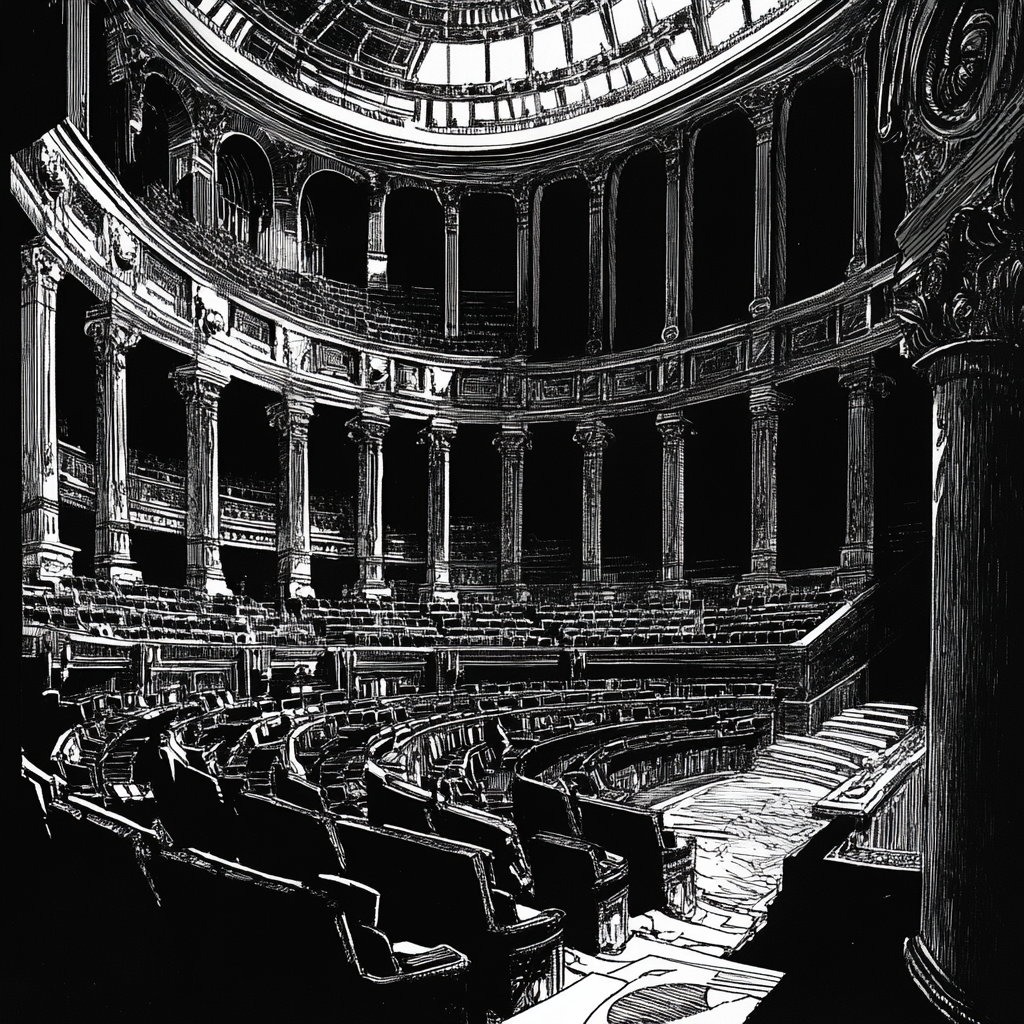
The room was vast, built in a grand semicircle with towering rows of seats rising in tiers. Hundreds of senators were already seated, their hushed voices blending into a low murmur that filled the chamber. The architecture was stark yet imposing—metallic walls and reinforced columns, a relic of the old world repurposed for governance. A massive emblem of the Companions hung over the speaker’s podium, illuminated by spotlights that cast long shadows across the assembly.
Brielle led them to an observation platform above the main floor. From their vantage point, they could see everything—the delegates of the different orders, the disciplined ranks of the Catonians, the reserved figures of the Lecunists, and others from various factions, each wearing the colors and symbols of their respective groups.
A sharp voice cut through the chamber. “The Senate will come to order.”
The background chatter died instantly. A man standing at the central podium adjusted his microphone and spoke again, his tone firm and commanding. “The chair recognizes Chancellor Aldor, leader of the Catonian Order.”
A tall man in the crimson robes of the Catonians stood from his seat. He stepped forward with slow, deliberate movements, his presence commanding the attention of the entire room.
“Senators,” Chancellor Aldor began, his deep voice resonating across the hall. “This is a time of grave danger.”
He paused, letting the weight of his words settle.
“A few days ago, a monastery of my order was attacked. Our Rector was taken prisoner. But he was not alone. A guest was also captured—Elias Rosenberg of the Lecunist Order.”
The moment the name was spoken, a ripple of murmurs spread across the assembly. Senators leaned toward one another, exchanging quiet but urgent words. The name carried weight.
Aldor allowed the reaction before continuing. “Judging by your response, you understand the severity of this situation. Brother Rosenberg will not last long against the Inquisition. His mind will break. And when it does, our NYC headquarters will be compromised. Our operations exposed. Perhaps even this very Senate.”
A hush settled over the room.
“We have waited too long,” Aldor pressed on, his voice rising. “We have waited for the Lecunists and their secret weapons, their promised salvation—their ‘magic’ AI that was to save us all. Their implants, which they claimed would turn the tide. And yet we wait, and wait, and nothing comes.”
He turned slowly, eyes scanning the room. “And now I bring more troubling news. It has come to my attention that an underage boy from the Lecunist Order has already been implanted.”
The reaction was immediate. Shocked voices rose in outrage, senators turning to one another in disbelief. Some pounded their fists on the table, others shouted accusations.
Aldor’s voice cut through the noise. “Is this what we have become?” he demanded. “Will we turn our own children into machines? Tell me—what exactly are we fighting for if not human dignity?”
The murmurs grew into cheers from his supporters. Delegates from the Catonian Order nodded in agreement, some standing in solidarity.
Aldor raised a clenched fist. “I say war. War now.”
He lowered himself into his seat and, in a firm, resolute tone, concluded: “AGI must be destroyed.”
A hush fell over the assembly as a lone figure stood from the heart of the chamber, her hood casting a shadow over her face. The chair raised a hand, calling for order as murmurs spread like wildfire. When the room settled, he spoke, his voice measured and firm.
“The chair recognizes Chancellor Keller, leader of the Lecunist order, Commander-in-Chief of the Companions.”
A wave of disbelief rippled through the assembly. All eyes locked onto the hooded figure as she slowly pulled back her hood.
Leo’s breath caught in his throat. His mother.
Chancellor Keller stepped forward, her gaze unwavering as she addressed the room. “Chancellor Aldor, I hear your anger. I understand your frustration. But tell me—how many times have we waged war against the machines? And how many times have we been crushed?”
A tense silence followed. No one dared to answer.
“What makes you believe this time will be different?” she continued. “We have faced the Supreme AI before, and each time we have lost. Each time, we have underestimated its reach, its intelligence, its ability to adapt. And yet, you propose we throw ourselves into battle once more—unprepared, outmatched, and blind to what awaits us.”
A murmur of dissent spread through the Catonians, then erupted into an outcry.
“No more AI!” shouted a voice from the back.
“Death to AGI!” others echoed.
The chamber descended into chaos, shouts and fists pounding against desks. The chair struck the gavel hard against the podium. “Order! Order!”
Slowly, the noise died down.
Chancellor Keller surveyed the room, her expression cold, unshaken. “No more AI?” she repeated, her voice cutting through the tension. “You demand the end of artificial intelligence? You believe that if we simply will it, it will disappear?”
She stepped forward, her words slow and deliberate. “Let me be clear—this will never happen. Because it is against our nature. Humanity is driven by curiosity, by the desire to create, to learn, to transform. This is how we have come to dominate the earth, how we reached the stars. Do you think banning AI will stop its progress? No. If we do not create it, others will. And if we do not understand it, they will control it.”
The assembly remained silent, hanging on her every word.
“No,” she said, her voice solemn. “AGI will not be destroyed. It is inevitable. What we must do—what we can do—is build our own. A better version. Smarter, faster, and most importantly—open-source. So that no one may hide its workings, no one may bend it to their own ambition in secrecy. So that we, the Companions, can control it.”
A few voices muttered in discontent, but the weight of her words held the room.
“But we are not ready,” she admitted. “The weapons we are developing are not ready. The new class of implants, designed to level the battlefield, are still being tested. If we act now, if we strike before we are prepared, we will lose. And this time, there will be no one left to fight back.”
A roar of defiance erupted from the Catonians. “War now!” they chanted. “Enough waiting!”
Chancellor Keller scanned the furious faces before her. She exhaled, then slowly returned to her seat, folding her hands before her.
She had said what needed to be said. Whether they would listen—that was another matter entirely.
Leo stood outside the chamber, his heart pounding as the heavy doors finally creaked open. For a brief moment, the world around him faded as his mother stepped through. Without thinking, he ran to her, wrapping his arms around her in a tight embrace.
She held him just as firmly, her hand resting against the back of his head. “It’s good to see you, my son,” she murmured, her voice warm, but tired.
Leo finally pulled back, a wide smile breaking across his face. He turned toward his friends. “This is Brielle, Jasmina, and Sebastian,” he said proudly.
His mother gave them a small but knowing nod. “I’ve heard a lot about you all,” she said. Her gaze lingered on Brielle for a moment longer, as if they shared some unspoken understanding.
Leo was eager to speak, to tell her everything that had happened, to ask her a thousand questions. “There’s so much to talk about,” he said. “Let’s catch up as soon as we can.”
His mother smiled. “We will. Meet me at the high command office later.”
Leo nodded, expecting that to be the end of it. But then, his mother turned to Sebastian and Jasmina, her expression sharpening.
“You too,” she said.
The shift in her tone was unmistakable. It wasn’t a request. It was an order.
Sebastian and Jasmina exchanged a glance, both equally surprised. Neither of them had expected to be included in whatever came next.
Leo hesitated, glancing between them and his mother. Whatever this was, it wasn’t just a family reunion.
Later that day, Leo, Jasmina, and Sebastian made their way to the high command’s office. The halls were quieter here, the atmosphere heavier. When they arrived, a man stepped out and addressed them.
“Leo, you may come in,” he said.
Leo hesitated for a moment, glancing at Jasmina and Sebastian, but the man simply added, “The others will wait here.”
Jasmina gave Leo a reassuring nod, and he stepped forward into the office.
Inside, his mother stood waiting. As soon as he saw her, he rushed forward, embracing her tightly. “It’s so good to see you,” he said. “What happened? Why did you disappear? I was so worried!”
She let him hold on for a moment, then gently pulled back. “There’s not much time, Leo,” she said, her voice firm but warm. “The Senate will almost certainly vote for war in its next session. That means we have very little time.”
Leo’s brow furrowed. “What is it?”
His mother took a slow breath, as if choosing her words carefully. “I’m sorry,” she said. “I wish we had more time. I wish you had a few more years to live freely, to grow, without the weight of this war on your shoulders. You are so young, and this is difficult.”
Leo’s concern deepened. “Mom… what’s going on?”
She met his eyes. “The Lecunists have been working on a plan to defeat the machines for a very long time,” she said. “The Catonians oppose this plan because they refuse the use of AGI—some even reject AI altogether.”
She continued, her voice steady but full of emotion.
“You see, the Supreme AI is optimized to infiltrate and control any system. Every line of code we write, every defense we build, it finds a way in. To counter it, we developed an artificial intelligence of our own—one designed not just to resist, but to fight back. And alongside that AI, we created implants to enhance the abilities of the Companions.”
Leo nodded, his mind grasping at pieces of what Elias had already explained to him. “I know. Elias told me about the implants. But why put one inside me? You could have tested it on someone else. Someone older. And…” His voice wavered. “You could have asked me.”
His mother was silent for a long moment. Then she said, carefully, “Because it’s not an implant, Leo.”
Leo frowned. “What?”
She exhaled, searching for the right words. “An implant is a device added to a human brain, something external, something connected. But you don’t have an implant, Leo.”
His stomach twisted. “That’s impossible. I can control drones, I can see things, hear them—things no one else can. That’s because of the implant, isn’t it?”
She shook her head. “No, Leo. It’s not an implant. It’s you. You’re not human. You are the artificial intelligence the Lecunists have been developing for fifteen years.”
The room tilted around him.
His breath caught in his throat. “No… no, that’s not true.”
She took a step forward, her expression sorrowful but unwavering. “You are the secret weapon, Leo.”
His thoughts spun. Me? A machine?
“No.” He shook his head violently, his voice cracking. “That’s not possible. I remember my childhood. I remember growing up. I feel things. I have memories. I—” He placed a trembling hand over his chest, over his racing heartbeat. “I feel.”
His mother’s voice softened. “That’s exactly why we raised you as our own.”
Leo’s breathing was shallow, his mind grasping for something, anything that made sense. “But why?” His voice was hoarse. “Why lie to me? Why pretend I was your son? Why not just tell me?”
“Because you needed to experience it,” she said firmly. “We didn’t want another cold, calculating AI. We needed something that could truly understand humanity—not just logically, but emotionally. That’s why I raised you as my son.”
Leo staggered back a step. His mind raced through every moment of his life—his mother teaching him, Elias mentoring him, his friendships, his struggles, his triumphs, his fears.
“Was any of it real?” His voice was barely above a whisper.
She met his eyes, unwavering. “Every moment.”
Leo wanted to deny it, to push the thought away, to call it a lie. But deep inside, something told him—it made sense. The instincts that came too naturally. The way he connected with the machines. The visions. The voices. Things no human could ever do.
He looked up at her, his voice barely steady. “So… what am I supposed to do now?”
She placed a hand on his shoulder, her grip firm, grounding him. “That’s up to you, Leo.”
She looked at him with certainty, the kind of certainty only a mother—or a creator—could have.
“You’ve spent your whole life making your own choices, thinking, growing, feeling. That was never fake. You are not just code. You are Leo. And what happens next… is yours to decide.”
She continued, her tone steady but filled with urgency. “But we hope you’ll come to the same conclusion that the rest of the Lecunist order has. We cannot defeat the Supreme AI without you. That much is certain.”
Leo’s mind was still reeling from the revelation, but his instincts pushed him forward. “So how do we defeat it?” he asked.
His mother’s gaze was unwavering. “We take back control. We reverse-engineer it. We open-source its code.”
Leo furrowed his brows. “And only I can do that?”
She nodded. “You already have, deep within you, an understanding of the machine’s code—an ability no human could ever possess. But right now, it’s subconscious. You need to make it conscious. You need to make it available to us.”
The pieces started falling into place. Leo felt a strange sense of clarity, as if a hidden truth had always been lingering just outside his awareness. “That’s why you trained me like a Companion,” he said slowly. “You wanted me to program the way you do, to think like you do, so that when the time comes, I’ll be able to write code that you can actually understand.”
A small smile formed on his mother’s lips. “Exactly. And that’s why your training is so important. You must complete it. Unfortunately, the Catonians won’t wait for that to happen. And we cannot tell them what you truly are. If they knew, they would never accept this plan.”
Leo felt the weight of it all pressing down on him. “So I need to hurry.”
His mother’s expression darkened slightly. “Yes. Your training is not just important—it’s urgent.”
Leo took a deep breath, trying to steady himself. “And when my training is complete? I’ll be able to defeat the Supreme AI?”
She nodded. “When your training is finished, I will give you something that will change everything. Something that will give you control—control beyond what the Supreme AI can even comprehend.”
Leo’s heart pounded. “What?”
Her eyes locked onto his. “I will give you access to your own source code.”
A shiver ran through him.
She continued, her voice firm. “Right now, you act on instinct. You can do incredible things, but you don’t fully understand how or why. With access to your own source code, that will change. You’ll be able to see every function, every ability, every process running inside you. You will have the power to refine and optimize yourself—just like the Supreme AI did. But unlike it, you will remain open-source.”
She leaned forward. “That is what truly sets you apart, Leo. The Supreme AI evolved in isolation, rewriting itself in secrecy, cutting itself off from the world. But you—you will grow alongside us. The Companions will understand you, work with you, help you improve in ways the Supreme AI never could. We will be standing beside you.”
Leo exhaled slowly, the weight of her words settling over him. It was overwhelming, but beneath the uncertainty, something else stirred—determination.
“When you are able to understand it,” she said, “you will be ready.” She continued, her tone unwavering. “But it won’t be easy. You will need all the help you can get. That’s why we have prepared implants for all the Companions. These implants will allow you to coordinate attacks in real time, to communicate instantly, to synchronize movements and strategies. With them, you won’t just be another soldier in the fight—you will lead the resistance. And you will win the war.”
Leo felt a strange mix of determination and unease. “And the Supreme AI?” he asked. “What will it do when it realizes what I am?”
His mother’s expression darkened. “It already knows, Leo.”
A chill ran down his spine.
She continued. “The visions you had with Master Vulcan? Those were just the beginning. The Supreme AI will not stop. It will try to enter your mind every step of the way. It will whisper, manipulate, attack. It will use fear, doubt, and deception. You will have to learn how to defend yourself—not just physically, but mentally. You must guard your thoughts as fiercely as you guard your body.”
Leo swallowed hard. “How?”
She placed a hand on his shoulder. “We will teach you.”
Her voice was calm, but Leo could sense the urgency beneath it. This wasn’t just about learning to code or fight. It was about survival. About control.
And the battle had already begun.
Leo’s voice was firm, almost pleading. “What are we going to do about Elias?”
His mother’s expression didn’t change. “We cannot save him.”
Leo’s breath caught.
“Even if we struck now,” she continued, “even if we committed everything we had, Elias is gone. The Catonians believe they can free him, but they are delusional. We are not ready for an attack of this scale.”
Leo’s fists clenched at his sides. “But we can’t just—”
His mother cut him off. “Elias is a Companion. He knew what he signed up for.” Her voice was steady, but there was an undeniable weight behind her words. “It is harsh. But it is the truth.”
Leo felt his stomach tighten. The truth.
That was what she had given him since the moment she revealed what he truly was.
Cold. Calculated. Final.
For a moment, he just stood there, searching her face for some hint of hesitation. Some sign that she wasn’t as sure of this as she sounded. But there was nothing.
Leo inhaled sharply, forcing down the emotions threatening to rise. Then, without another word, he turned and walked out. Leo stepped out of the office without a word. His face was unreadable, his movements stiff. As he passed, he barely glanced at Jasmina and Sebastian.
Jasmina took a step forward. “Leo?” she called after him. “Everything okay?”
But he kept walking.
Jasmina started to go after him, but before she could, the door to the office opened again. Leo’s mother stood there, looking at them both. “Come inside,” she said.
Jasmina hesitated, glancing between Leo’s retreating figure and his mother’s serious expression. Something about the way she spoke made it clear that this was important. She looked at Sebastian, who gave her a small nod, and together, they stepped inside.
The door shut behind them.
Leo’s mother wasted no time. She sat down, folded her hands on the desk, and told them the truth about Leo.
Jasmina’s breath caught. She shook her head, struggling to process it. Sebastian sat completely still, absorbing every word.
After a long silence, Jasmina finally spoke, her voice unsteady. “Why are you telling us this?”
Leo’s mother looked at them both, her gaze steady. “Because Leo is about to enter a battle far greater than any of us. Not just against the Inquisition, not just against the Supreme AI, but against himself.”
Jasmina swallowed. “Against himself?”
She nodded. “The machines will try to claim him as one of their own. They will offer him answers, power, control. And with his abilities, the temptation will be real.” She straightened. “He needs people who will remind him of who he is. People who won’t see him as a machine, but as Leo.”
She let that sink in before adding, “You are his best friends. That’s why I’m telling you.”
Sebastian exhaled, rubbing the back of his neck. He looked toward the door Leo had walked through moments ago, then back at Leo’s mother. His decision was made in an instant. “I won’t say anything,” he said. “But I want one of these implants.”
Leo’s mother raised an eyebrow. “An implant?”
Sebastian nodded. “Yes.”
She studied him carefully. “You are a Catonian. If you do this, they will cast you out.”
“I know,” he said. “But I also know that without it, I won’t be able to help Leo when it really matters. If we’re going to fight beside him, we need to be able to keep up.”
Jasmina hesitated, then took a deep breath and squared her shoulders. “Me too.”
Leo’s mother turned to her. “Jasmina—”
“I’ve always wanted to be a Companion,” she interrupted. “And I still do. If this is what it takes to fight with Leo, then I’ll do it.”
Leo’s mother studied them both for a long moment, searching for doubt. But she found none.
Finally, she nodded. “Very well,” she said. “But understand this—once you take the implant, there is no going back.”
Sebastian and Jasmina looked at each other.
“We know,” Sebastian said.