Jasmina and Leo were caught off guard on Saturday morning. They had expected to do their usual chores, but Martin greeted them with a grin.
“Not today,” he said. “It’s the weekend. We play games.”
Curious, they followed him outside. The monastery grounds looked different—livelier. Groups of teenagers were spread across the fields, engaged in various competitive games. Some were wrestling on tatamis, others were racing, and a few were playing what looked like a futuristic version of chess.
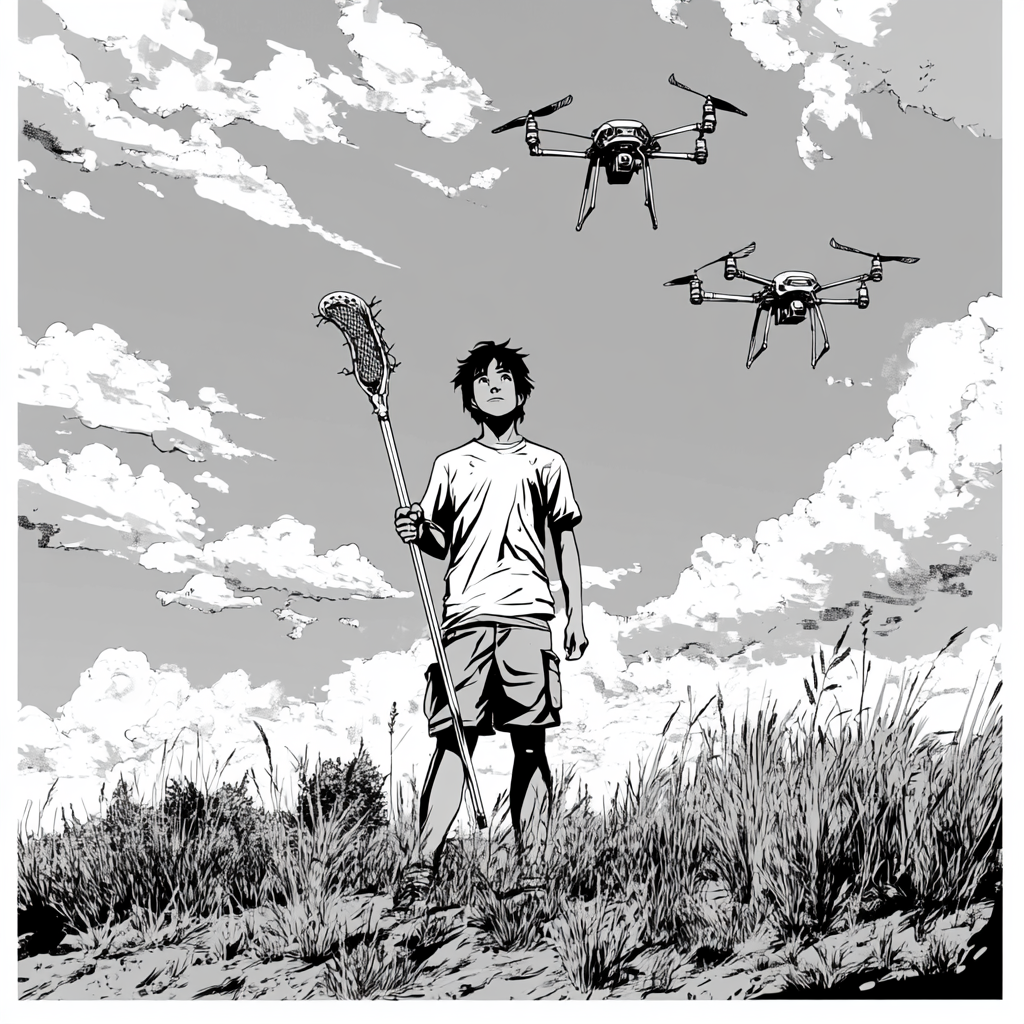
Martin led them toward a large field where a fast-paced game was underway. Players dashed across the field, wielding lacrosse sticks, but with one major difference—each player was controlling drones.
“This is drone lacrosse,” Martin explained. “It’s a great way to train your drone skills. See how they use their drones to block opponents, catch the ball, and even pass? They can even lift themselves off the ground for a short time.”
As he spoke, one of the players stepped onto his drone and soared a few feet into the air to intercept a pass.
“But,” Martin added with a smirk, “you don’t want to go too high. If someone knocks your drone out while you’re in the air… well, let’s just say the landing isn’t fun.”
Jasmina and Leo watched in fascination as the game played out. The speed, the strategy, the mix of physical skill and drone control—it was unlike anything they had seen before.
When the match ended, a group of players jogged toward them. Leading them was a tall, athletic boy with short, dark hair.
“Sebastian,” Martin introduced him. “He’s fifteen, one of the best lacrosse players here.”
Sebastian flashed a confident grin. “You guys never seen a drone game before?”
Leo shook his head, still trying to process what he had just watched.
Sebastian nodded knowingly. “They’re huge among Companions. We train for international tournaments. Best players from every Companion faction go head-to-head.”
Jasmina and Leo exchanged a glance. The idea of an international tournament for something like this was incredible.
Sebastian twirled his lacrosse stick. “Wanna try?”
Leo hesitated, but before he could say anything, Jasmina stepped forward. “Sure!”
Sebastian’s grin widened. “Alright, let me show you the basics.”
He handed her a stick and guided her through the movements—how to hold it, how to scoop and throw the ball, and most importantly, how to use the drones to assist.
Leo watched closely, feeling both nervous and excited.
A few more teenagers arrived on the field, drawn by the excitement of the game. Sebastian waved them over.
“Hey, we’ve got two newcomers,” he announced. “Jasmina and Leo. They’ve never played before, so let’s keep it light and improvise a quick match.”
Leo took a step back. “Uh, I think I’ll just watch—”
Before he could finish, Jasmina grabbed his arm. “I only play if you play,” she said with a teasing grin.
Leo sighed. “Jasmina—”
She didn’t let go. “Come on, it’ll be fun.”
Sebastian clapped him on the shoulder. “Yeah, don’t overthink it. Just run around, mess with your drone. You’ll get the hang of it.”
Reluctantly, Leo gave in. “Fine.”
The game began, and at first, both Leo and Jasmina ran awkwardly across the field, trying their best to keep up. They swung their lacrosse sticks wildly, missing more passes than they caught. Their drones buzzed unpredictably, sometimes reacting too late, other times drifting aimlessly.
The others laughed good-naturedly but kept passing them the ball, encouraging them to keep trying.
Sebastian called a quick break and jogged over to Leo. “Here, let me show you something.”
He demonstrated a simple move, extending his hand forward in a smooth motion. His drone shot forward and nudged the ball precisely where he wanted it to go. “Try it.”
Leo mimicked the motion. His drone zipped forward in response.
Sebastian’s expression shifted from friendly enthusiasm to complete confusion.
“Wait…” he muttered, staring at Leo. “That’s not your drone. That’s mine.”
Leo blinked. “What?”
“You just moved my drone,” Sebastian said slowly. “How did you do that? Did you hack into it?”
Jasmina’s eyes widened. “Leo… is that true?”
Before he could answer, the other teenagers ran over, intrigued by the conversation.
“Try mine!” one of them said, holding up his hands. “Can you control mine?”
Leo hesitated, then made a similar gesture. The drone responded.
The group let out a collective gasp.
Sebastian shook his head in disbelief. “No way. That’s insane.”
Leo started to feel a rush of excitement. For once, the attention was on him, and not because he was in trouble. Grinning, he lifted both hands and made an upward motion.
Every drone on the field lifted off at once.
The murmurs of shock turned into outright amazement. The crowd around him grew as more players and onlookers gathered.
Jasmina was beaming. “That’s awesome, Leo!”
Encouraged, Leo gestured again, commanding the drones to form patterns in the sky—circles, waves, synchronized movements that looked almost like a dance. The teenagers stared up in awe, laughing and cheering.
For the first time in a long while, Leo felt powerful.
Then, as he lowered his hands and let the drones return to their original owners, he turned back toward Martin.
Standing just behind him, watching from a distance, was the Rector.
His expression was unreadable, but there was no mistaking the tension in his posture.
Without a word, the Rector turned and walked away.Martin led Leo through the quiet halls of the monastery, his steps measured, his expression unreadable. When they reached the heavy wooden doors of the Rector’s office, Martin stopped and turned to him.
“Wait here,” he said before stepping inside.
Leo stood in silence, but the voices from within were unmistakable. Tense words cut through the thick wood, sharp and unrelenting. Though he couldn’t make out every word, he knew exactly what—or rather, who—they were arguing about.
A moment later, the door opened, and Martin gestured for him to enter.
Inside, Elias stood near the Rector’s desk, arms crossed, his face set in a hard line. The Rector sat behind his desk, his expression carefully neutral. Across from him stood another man—older, dressed in the robes of a Catonian scholar. His stance was rigid, his eyes never landing directly on Leo.
“This cannot be allowed,” the man said firmly. “An implanted individual living among us? It is against everything we stand for.”
The Rector’s tone remained measured. “Brother Bernardo, our duty is also to offer refuge to our fellow Companions.”
Bernardo’s lips pressed into a thin line. “Companions?” He motioned toward Leo. “How do we know that? How do we know this isn’t an Inquisitor’s ploy?”
Elias shifted, his posture tense, but the Rector raised a hand, keeping the conversation from escalating.
Then, after a brief silence, he said, “He is the son of the Commander in Chief.”
Bernardo’s reaction was immediate. His shoulders went rigid, his breath catching for the briefest moment. He finally glanced at Leo—just for an instant—before turning back to the Rector.
“That,” he said carefully, “is not widely known, I assume.”
“No,” the Rector replied. “And it must remain that way, for his safety.”
Bernardo exhaled, his expression dark. He took a step back, considering his next words carefully.
“I have lost too many brothers and sisters fighting men with implants,” he said finally. “AI, implants, all of it—it always ends the same way. You know that as well as I do.” His voice was quiet, but resolute. “This time will be no different.”
Without waiting for a response, he turned and left, closing the door firmly behind him.
The silence stretched for a moment before the Rector turned to Leo.
“Forgive Brother Bernardo,” he said. “He has seen firsthand what the Inquisition’s technology has done to our people.”
Leo didn’t answer.
The Rector’s expression remained composed, but his voice carried a quiet weight. “That said, he is not wrong about one thing. You were told to stay unnoticed. Drawing attention to yourself in such a manner was careless.”
Elias finally spoke, his tone controlled but heavy with disapproval. “You understand how dangerous this could have been?”
Leo answered. “I didn’t think—”
“No, you didn’t,” the Rector interrupted. “That cannot happen again.”
Joaquim led Leo and Jasmina into the classroom filled with older students focused on their screens. The steady tapping of keyboards filled the room. He gestured toward two empty seats.
“I don’t have time to run a separate lesson for you,” he said. “So you’ll sit with the older students and work on your own. If you have questions, ask Sebastian.”
Sebastian walked over, dropping into the seat next to them. “Alright, let’s get started.”
Joaquim continued, “Today, you’re going to learn about automata. These are simple machines that process sequences of symbols, moving between different states based on what they read. Automata are used everywhere in computing—text processing, data validation, even artificial intelligence.”
Jasmina and Leo leaned in.
Sebastian took over. “An automaton is a system with rules. It starts in one state, reads characters one by one, and based on what it sees, it moves to the next state or stays where it is. Each state is represented by a label in our assembly program, and transitions happen when we compare the current character to something we’re looking for.”
Leo thought for a moment. “So it’s like a flowchart?”
“Exactly,” Joaquim said. “And today, you’re going to write an automaton that checks if a string is a valid email. The simplified version we’ll start with has two states—first, we look for an @, and if we find it, we move to the next state, where we look for a ..”
Sebastian pulled up the program.
http://closedsourcebook.com/asm_automaton.html
Sebastian pointed to the first part. “This program starts by looking for an @ symbol. It reads each character, prints it to the screen, and checks if it’s an @. If it finds one, it moves to the find_dot state.”
Jasmina followed along. “And if it doesn’t find an @, it keeps looping through find_at, right?”
“Exactly,” Sebastian said. “If it reaches the end of the string without finding @, it jumps to invalid, printing F for false.”
Leo traced the next part of the program. “And if it finds @, it moves to find_dot, where it does the same thing but now searching for a .?”
Sebastian nodded. “Right. If we find a . before the end of the string, we go to valid and print T for true. Otherwise, if we hit the end of the string first, we jump to invalid.”
Joaquim stepped in. “This is the fundamental idea behind automata. You move through states based on conditions. Right now, this automaton has only two states, but more complex ones can have many more.”
Jasmina leaned forward. “So if we wanted to make it more advanced, we could add more states to check other rules—like making sure there’s something before and after @?”
“Exactly,” Sebastian said. “But first, try this version out. Make sure you understand every step before we make it more complex.” Joaquim stepped forward, looking at the fascinated expressions on Jasmina and Leo’s faces. “Now that you understand how an automaton works, let me introduce you to a more compact and convenient way of representing them—a language that programmers use all the time. They’re called regular expressions.”
Jasmina and Leo exchanged a glance.
Joaquim continued, “A regular expression is a way to describe an automaton without manually writing out the states and transitions like we just did. Instead of constructing the automaton step by step, we write a single expression that captures the same logic. It might seem abstract at first, but once you get used to it, it’s an incredibly powerful tool.”
He turned to the board and wrote:
ab
“This is our first basic rule: concatenation. This means that ‘b’ must come directly after ‘a.’ Simple, right?”
Jasmina nodded. “Like writing a word—one letter follows another.”
“Exactly,” Joaquim said. “Now let’s introduce another operation: union.” He wrote:
a(b|c)
“This means that we start with ‘a,’ and after that, we can have either ‘b’ or ‘c.’ The vertical bar | means ‘or.’ So this expression matches either ‘ab’ or ‘ac.’”
Leo’s eyes lit up. “So it’s like a branching path in the automaton.”
“Precisely,” Joaquim said. “Now, the last essential operation—the star.” He wrote:
a*
“This means that ‘a’ can appear zero or more times. It could match an empty string, ‘a,’ ‘aa,’ ‘aaa,’ and so on, endlessly.”
Jasmina leaned in. “So it’s like a loop?”
“Exactly. And these three operations—concatenation, union, and the star—are all you need to define any regular expression. They are the building blocks of everything else.”
Joaquim then turned to the class. “Of course, for convenience, we have other symbols that simplify things. For example, + is similar to *, except it means ‘one or more’ instead of ‘zero or more.’ The ? means ‘zero or one’—it makes something optional. There are also ways to express negation, character ranges, and more. But everything can ultimately be expressed using just the three fundamental operations.”
He gave a few more examples, showing how more complex patterns could be constructed from these simple building blocks.
“Now,” Joaquim said, “here’s something very important to remember: regular expressions and automata are two sides of the same coin. Every automaton can be written as a regular expression, and every regular expression can be turned into an automaton. In fact, when computers process regular expressions, they first convert them into an automaton behind the scenes, just like the one we wrote earlier. Then they use a program—very similar to what you just implemented—to run the automaton and match patterns.”
Leo’s eyes widened. “So every time we search for something in a text file using a regular expression, there’s an automaton running in the background?”
“That’s exactly right,” Joaquim confirmed. “Now, let’s put this into practice. We’re going to write a regular expression that matches an email address—just like our automaton did.”Joaquim turned to the board and wrote:
.*@.*[.].*
“Alright,” he said, facing Leo and Jasmina, “let’s break this down step by step. This is a simplified regular expression to check whether a string resembles an email address. But before we start, I want to make it clear—this is not the official way to validate email addresses. Email formats are actually much more complex, but this will give you a solid understanding of how regular expressions work.”
He pointed to the first part:
.*
“This part might look simple, but it’s very powerful. The . means ‘any character’—it can be a letter, a number, a symbol, anything. The * means ‘zero or more times,’ which allows any sequence of characters, including an empty string.”
Jasmina tilted her head. “So this means we can have anything before the @?”
“Exactly,” Joaquim nodded. “Now let’s move on.”
@
“This part is straightforward. It means we expect the @ symbol to be here, exactly at this position.”
Leo smirked. “If it wasn’t there, then it wouldn’t be an email.”
“Precisely,” Joaquim said, moving to the next section.
.*
“This is the same as before—any number of any characters. This ensures that after the @, there’s at least something, like a domain name.”
“So this would allow @.?” Leo asked.
“Good question,” Joaquim said. “For now, yes, it would. But the next part fixes that.”
[.]
“This is a literal dot inside square brackets, which means the next character must be a period (.). Normally, a . in a regular expression means ‘any character,’ but since we actually want a dot, we put it inside brackets to make sure it is treated as a real dot.”
Jasmina nodded. “So this makes sure there’s a dot after whatever is after the @?”
“Exactly,” Joaquim said, pointing to the final section.
.*
“This works just like before—any number of any characters. It ensures there’s something after the dot, like .com, .net, or .org.”
Jasmina exhaled. “So this makes sure an email has a basic structure: something before the @, something after it, a dot, and then arbitrary characters.”
“That’s right,” Joaquim said. “Again, this is not a fully accurate way to validate an email, but it shows you how regular expressions describe patterns efficiently.”
Leo grinned. “I see why programmers like these. It’s a way to write an automaton in a single line.”
“Exactly,” Joaquim said. “And now, let’s test this expression in practice.”
He pointed them to a console where they could try matching different strings using:
http://closedsourcebook.com/regexp.html. Joaquim leaned against the desk, arms crossed, as he watched the class absorb his lesson. “Regular expressions,” he continued, “are something you’ll use all the time. Whether it’s searching for patterns, validating inputs, or parsing text, they’re everywhere.”
A boy sitting a few rows behind Leo and Jasmina smirked. “Yeah, perfect for validating matching parentheses,” he said with a mischievous grin.
Joaquim sighed, half amused, half exasperated. “Well, Erling,” he said, eyeing the boy, “I wasn’t planning to get into that today, but since you brought it up…”
At that moment, the drone hovering behind Joaquim echoed in a monotone voice, “Since you brought it up.”
Erling’s grin widened. Joaquim narrowed his eyes. “Erling, did you hack into the school’s system again?”
The boy shrugged, unbothered. “I mean, if the school actually updated their software once in a while, it wouldn’t be so easy.”
Joaquim shook his head. “Alright, fair enough. We’ll update it. But let’s get back on track. You see, regular expressions are powerful, but they have limits.”
Jasmina looked intrigued. “Like what?”
Joaquim paced in front of the class. “Let’s say I want to check if a string has properly balanced parentheses or brackets—meaning every ( has a matching ), and every [ has a matching ]. For example, ([][]) and []()[[[]]] are correct, but ) or ([)] are incorrect. Sounds simple, right?” He paused, letting the question hang. “Well, regular expressions can’t do that.”
Leo frowned. “But… why not? Can’t we just write a pattern that says, ‘match any ( and then make sure there’s a ) later’?”
Joaquim smiled. “That’s a reasonable assumption. In fact, let’s take a different approach. You now know that every regular expression has an equivalent automaton. So if a regular expression could match balanced parentheses, then we should be able to write an automaton for it, right?”
Jasmina nodded. “Okay… so what would the automaton look like?”
Joaquim raised a finger. “Let’s think through the states. We start in an initial state. If we read an opening (, what happens?”
Jasmina thought for a moment. “We go into a new state. Same thing if we see [. But if we see ) or ] first, that’s an error, right?”
“Exactly!” Joaquim nodded. “Now, let’s think about what happens as we continue reading the string. Suppose the first character was (—what should we do when we encounter the second character?”
Leo hesitated. “We have to match the whole sequence, and then at the end, make sure there’s a closing ).”
Joaquim smiled. “Right. And how would we express that in an automaton?”
Leo and Jasmina exchanged a look. After a moment, Jasmina said, “Wait… we can’t.”
Joaquim snapped his fingers. “Exactly! You can’t express it with a standard automaton because you need memory. You need to remember that you saw an opening ( or [, and the problem is, automata don’t have memory. They just go from one state to another based only on the current character they’re reading. They don’t get to ‘remember’ what came before.”
Joaquim moved to the board and drew a simple diagram. “An automaton works by changing states as it reads a string. But it can’t look back. It only reacts to the present input. If you read an opening (, there’s no way to store that information and retrieve it later when you finally encounter a ).”
He turned back to the class. “This is why we need something extra—a stack.”
Jasmina sat forward. “What does a stack do?”
Joaquim stepped to the side of the room and picked up a stack of books from a nearby desk. “Think of a stack like a pile of books. If I place a book on top,” he set one down, “then another,” he stacked a second book, “and another,” he stacked a third, “I can only take them off in reverse order—the last book I put on is the first one I take off.”
He removed the top book and placed it aside. “That’s exactly how we solve the parentheses problem. Every time we see an opening ( or [, we push it onto the stack. When we see a closing ) or ], we pop from the stack and check if they match.”
Joaquim set the remaining books down. “If we reach the end of the string and the stack is empty, that means every opening symbol had a matching closing one. If the stack isn’t empty, something was left unmatched. If we ever try to pop and the stack is already empty, that means we found a closing symbol without an opening one, which is also invalid.”
Leo’s expression lit up. “So that’s why automata alone don’t work! They don’t have a way to remember what they saw earlier.”
“Exactly,” Joaquim said. “This is why automata alone aren’t enough for this problem. To match something as simple as parentheses, we need a stack. We need memory.” “Now, let’s take a look at the assembly program that actually does this.”
Joaquim gestured toward the screen. “You can find the source code here: http://closedsourcebook.com/asm_stack.html,” he said, letting the class take it in.
“Now, don’t be intimidated by the size of the code,” he continued. “It might look complex at first, but if you break it down, you’ll see it’s really just an automaton like before. The only difference is that instead of jumping from one state to another immediately, we’re interacting with the stack every time we process a character.”
He pointed at the first part of the program. “Like before, we have states. But now, the key operations are push and pop. When we encounter an opening ( or [, we push it onto the stack. That means we’re keeping track of what needs to be closed later. If we see a closing ) or ], we pop the last thing from the stack and check if it matches. If it does, we continue. If not, we stop with an error.”
Joaquim let the words sink in. “That’s all it is. A systematic way of ensuring that every opening bracket has a matching closing bracket. If the stack is empty at the end, the input is valid. If it’s not—then something went wrong.”
Jasmina leaned in, scanning the code. “So every time we process a character, we’re checking the stack?”
“Exactly,” Joaquim said. “And once you understand that, the rest is just details.”
Leo nodded slowly. “Okay… I think I get it.”
Joaquim smiled. “Good. Because once you understand stacks, you’re well on your way to understanding recursion, function calls, and how programming languages actually work under the hood. But one step at a time.”
Joaquim turned back to the board, gesturing toward the example they had just worked through. “Now,” he said, “let’s talk about something important. Up until now, we’ve been managing our own stack in memory—storing values, moving a register to keep track of it, and loading and storing data manually. But the processor has a built-in stack specifically designed for this.”
Leo and Jasmina leaned in, intrigued.
“This built-in stack,” Joaquim continued, “is called the execution stack. The processor uses it internally, and we can also take advantage of it. Instead of manually managing a stack with memory addresses, we use two special instructions: PUSH and POP. These instructions let us push values onto the stack and retrieve them later, just like we did before, but now the processor handles the details.”
He pointed at a new section of code on the screen. “We’ve updated our program to use this native stack instead of managing our own. Every time we PUSH, the processor stores a value at the top of the stack and moves the stack pointer down. When we POP, it retrieves the last stored value and moves the stack pointer back up. The register that tracks the stack’s position is called SP, or ‘Stack Pointer’. You can actually see its value changing in the emulator when you step through the code.”
Jasmina’s eyes lit up. “So it’s doing the same thing, but in a more efficient way?”
“Exactly,” Joaquim said. “Under the hood, it’s still just memory—just like our manually managed stack. But this special memory region is predefined, and the processor gives us fast, easy-to-use instructions to work with it.”
Leo was already looking at the emulator screen. “So every time I push something, SP decreases?”
“That’s right,” Joaquim confirmed. “And when you pop, SP increases again. This stack is used for more than just storing data—you’ll soon learn that it plays a critical role in function calls as well. But we’ll get to that later.”
He tapped a command on his console, and a new example appeared. “You can check out the revised version of our program here: http://closedsourcebook.com/asm_native_stack.html. Run it step by step and pay close attention to how SP moves. That’s the key to understanding how the processor’s native stack works.”
Leo and Jasmina exchanged a glance, excited to try it out.
Martin met Leo and Jasmina at the main entrance, his excitement evident. “Today is a special day,” he announced. “It’s tournament day at the school.”
Jasmina and Leo exchanged glances, intrigued.
Martin explained further. “The whole school gathers for sparring contests. It’s a duel-based system, where students—and sometimes even teachers—challenge one another. Every victory earns points, much like an ELO ranking in chess, helping determine the best drone fighter in the school.” His chest swelled with pride as he continued, “There are two categories: junior and senior. But when a junior is exceptionally skilled, they can challenge seniors. Like Sebastian, for example—he’s so good that he’s rivaled some of the school’s best teachers.”
Leo and Jasmina listened intently, curious about how the tournament worked in practice, but there was little time to ask questions. It was time for lunch. As usual, they sat with Elias and Brielle, though they couldn’t discuss anything—silence was expected during meals.
After lunch, the entire student body followed the Catonian monks downstairs into a vast underground arena. Tiered seats had been arranged for the occasion, filled with students, teachers, and the older monks of the monastery. A long platform stood at the center, the designated battlefield. At the far end, an elevated section housed the professors and the Rector, who presided over the event.
The crowd settled as the Rector stood, his voice ringing through the chamber. “The tournament begins,” he declared solemnly. “Let the first challenger step forward.”
Brenda rose to her feet, the reigning champion from the last games. She strode confidently to the center of the arena. “You know the rules,” the Rector said. “Choose your opponent.”
Leo turned to Martin. “Isn’t it too easy if you just get to pick who you fight?”
Martin shook his head. “The point system balances it. If you beat someone weaker than you, you barely earn points. To maximize your score, you need to defeat someone stronger.”
Jasmina considered this. “So the best strategy is to challenge someone you have a chance of beating—but who’s as strong as possible?”
Martin grinned. “Exactly.”
He continued, “But sometimes, challenges aren’t just about points. Some fights are honor duels—a way to test oneself. People have even challenged the Rector before, though it’s more for the prestige than anything else. And there are rules. No laser fire, and no flying.”
In the center of the arena, Brenda smirked and called out, “I challenge Elias Rosenberg.”
There was a murmur through the crowd. Elias, who was sitting among the professors, blinked in surprise. He glanced left and right, hoping for a way out. He turned to Brielle. “Lecunists aren’t big on duels,” he muttered.
Brielle nudged him with a smirk. “Too late for that.”
Elias sighed and reluctantly stood, walking toward the center of the arena. Someone handed him two drones, the standard set for the tournament. Brenda stood across from him, bowing slightly in respect.
The fight began.
Brenda assumed a combat stance, expecting Elias to engage physically. But instead of mirroring her, Elias simply sat down on the floor. His legs crossed, hands hovering over his knees. His drones floated steadily above his palms.
The crowd murmured. Brenda frowned, taken aback.
She decided to test him, stepping forward and attempting a kick toward one of his drones. It moved effortlessly to block her. She sent her own drones in, but Elias flicked a hand, intercepting them with his own.
Brenda narrowed her eyes. He’s better than I expected.
Realizing she wouldn’t be able to outmaneuver him with brute force, she shifted her focus entirely to the drones. Elias, seeing that she wouldn’t engage physically, stood as well. Now, it was purely a battle of drone control.
Brenda launched a swift attack, her drones darting forward in unison. Elias countered with sharp precision, deflecting each move. Then, in a sudden strike, he knocked one of Brenda’s drones to the ground.
The crowd gasped.
Now down to one drone, Brenda made a desperate final attempt, sending her remaining drone in a fast, sweeping strike, aiming to take out both of Elias’ drones at once. She managed to hit one—but the second drone remained hovering.
Silence filled the arena.
Brenda, now defenseless, took a step back. Then, she exhaled and bowed. “I resign. Good fight.”
The younger students burst into applause. Jasmina cheered. Even Leo, who was usually reluctant about these kinds of things, smiled in satisfaction.
But among the older monks, the reaction was far less enthusiastic. Some remained silent, arms crossed. Bernardo, standing in the background, observed with a hard, disapproving expression.
The Rector rose to his feet, his voice carrying through the great hall. “Now, for the mixed Junior/Senior category, I call Andreas Brown and Sebastian Miller.”
Andreas stepped forward, his posture confident as he addressed the crowd. “I call the Rector to second me.”
A murmur of approval spread through the audience. The Rector, visibly pleased by the choice, gave a nod and made his way to the center of the stage. Applause filled the hall, students eager to witness a match involving their leader.
Then, all eyes turned to Sebastian.
The mixed category worked differently from the others—each junior was responsible for selecting a senior as their partner. This system balanced experience and skill, allowing younger students to compete alongside seasoned fighters.
Sebastian let the anticipation build before finally pointing toward Leo. “I call Leo, whose last name I don’t know, from the order of the Lecunists.”
The hall went silent.
A ripple of confusion spread through the crowd. The Rector glanced around the room, his expression unreadable, before finally speaking. “The purpose of the mixed category is to have a junior paired with a senior. Since you are a junior yourself, you must select a senior. That is how we maintain balance.”
Sebastian’s voice was steady. “If the Rector allows it, I would like to take my chances. I understand that two juniors are at a disadvantage, but I believe we have a shot.”
A wave of murmurs swept across the hall. Jasmina, grinning, grabbed Leo’s wrist and lifted it high.
“Leo! Leo! Leo!”
The chant spread quickly. Students pounded their fists on the benches in excitement.
Leo’s pulse quickened. He glanced toward Elias.
Elias was watching him from across the hall, his expression firm, his gaze unwavering. There was no need for words. Everything in his eyes said one thing: don’t.
The Rector raised a hand, and the chanting faded. “One moment, please.”
He gestured for the senior monks to follow him offstage. As they stepped away, the students leaned toward each other, whispering.
Leo stood stiffly. Part of him hoped the monks would allow it. The other part wasn’t so sure.
The Rector returned, his expression grave. He lifted a hand, calling for silence.
“The council has decided. It is against our rules to have two juniors compete in the mixed Junior/Senior category. The decision is final.”
The reaction was immediate—students muttered in frustration, shifting uneasily on the benches. A few of the younger ones looked to Sebastian, as if expecting him to challenge the ruling. But he remained still.
Then, unexpectedly, the Rector raised his voice once more.
“This tournament is adjourned. We will restart next month.”
For a moment, no one moved. The announcement caught everyone off guard. Slowly, the energy in the hall shifted. Confusion spread, whispers turning to murmurs of discontent.
One by one, students began filing out, their excitement from earlier replaced by uncertainty. The decision had been made. No one dared to argue.
As the crowd dispersed, the Rector gestured for Elias and Brielle to follow him. Bernardo rose from his seat and trailed after them without a word.
In a small chamber near the main hall, the air was tense. The Rector turned to Brielle. “You have to leave.”
Bernardo gave a small nod in agreement.
Brielle exhaled slowly. “We’ll be on our way Monday.”
A silence settled over the room, weighted with finality. Then, just beyond the doorway, the faint sound of footsteps echoed in the hall. A hesitant pause, followed by a light knock.
Sebastian stood at the threshold, glancing between the gathered figures. Though the tension inside was palpable, he squared his shoulders and took a step forward.
“May I come in?”
The room fell silent. The Rector turned his gaze toward him. “What is it, Sebastian?”
Sebastian hesitated for only a second. “I think this conversation might be better had with a smaller audience.”
The Rector looked around at the others—Brielle, Elias, and Bernardo—before shaking his head. “We are among trusted senior members of our order. You may speak freely.”
Sebastian squared his shoulders. “I would like to protest what happened today.”
The Rector’s expression hardened. “You don’t have all the information. You should trust your elders to do what is right for the order.”
Sebastian didn’t back down. “He has an implant, doesn’t he?”
The room tensed. The question hung in the air like an unspoken accusation.
The Rector’s eyes narrowed. “Who told you this?”
“Nobody,” Sebastian replied. “I simply guessed. No one can do what Leo did with drones without an implant.”
Bernardo exhaled sharply, stepping forward. “And that is exactly why we couldn’t let him compete in our games,” he said. “It’s against our rules.”
Sebastian didn’t flinch. Instead, he took a step closer. “Is he not exactly what we need?”
The question caught them off guard.
Sebastian pressed on. “The Inquisitors are all equipped with implants. The games are meant to prepare us for real battles. What good is our training if we refuse to fight against what’s actually out there?”
Elias, who had remained silent, studied Sebastian with newfound interest.
Bernardo’s expression remained composed, but there was something restrained behind his eyes. “Do you know why we have you do chores, Sebastian?” His tone was calm, almost instructional. “We could easily have drones tend to our gardens, clean our dishes, and maintain the monastery.”
Sebastian hesitated but didn’t answer.
Bernardo continued, his voice steady. “Because the Catonians teach what it means to be human. To be independent. Not to rely on machines for survival. We don’t need AI. We lived without it for thousands of years, and we can go back to that time.”
Sebastian’s jaw tightened. He chose his next words carefully. “I understand. And I’m grateful for what the Catonians have taught me.” He hesitated, then added, “But I must admit that my trust in the order, today, has been shaken.”
A heavy silence followed.
The weight of his words was clear.
Sebastian took a breath and continued, his voice steady. “If we’re going to fight machines, we need to use every weapon we can. And that includes training against opponents who can teach us how to defeat them. Imagine if we refused to use drones at all. What chance would we have?”
He looked between them, letting the question settle. “I understand what the Catonians are doing. This is my culture, my home, my friends. But I fear we are on going to be on the losing side of history.”