At exactly 6 PM, Leo stepped out of the school gates.
And there, waiting at the curb, leaning casually against an old, battered car, was Elias.
Leo walked toward him, keeping his pace steady, trying not to look too eager—or too relieved.
When he got close enough that only Elias could hear him, he muttered, “My uncle, I guess?”
Elias wasn’t amused. “Shut up and get in.”
Leo climbed in, and Elias shut the door behind him.
Leo barely had time to settle in before something strange caught his attention. Elias wasn’t sitting in the passenger seat. He was behind the wheel.
The car wasn’t driving itself.
Leo stared as Elias placed his hands on the circular control mechanism, pressed his foot against something near the floor, and the car moved.
Leo’s mouth hung open. “Are you… are you operating this thing with your hands?”
Elias smirked. “It’s called driving.”
Leo had never heard the word before.
Elias continued, eyes focused on the road. “There are still enough roads to get around the city if you know where to go. And trust me—it’s way more fun than the subway.”
The car rumbled beneath them, nothing like the smooth, automated trains Leo was used to. He felt the vibrations through his seat, the subtle shifts in movement as Elias adjusted controls manually. It was strange. It was alive.
For the first time since entering the school, Leo felt like he was actually moving—not just being transported.
After a few minutes of quiet, Elias sighed. “I’m sorry.”
Leo looked at him, confused. “For what?”
“I didn’t realize they would assign you a school so quickly.” Elias’s grip on the wheel tightened. “I didn’t realize they’d send you to the abattoir so quickly.”
Leo frowned. “The what?”
Elias glanced at him, then back at the road. “It’s a French word. It means slaughterhouse.”
Leo’s stomach turned. “Why do you call it that?”
Elias’ grip on the wheel tightened, his knuckles turning white. “Because that’s what it is!” His voice was sharp, filled with frustration that had clearly been simmering for a long time.
“They feed you garbage. They kill your ability to think with those endless, brain-numbing feeds. And those games—” he scoffed, shaking his head. “I actually like video games. Real ones. Games that make you think, that let people build, create, explore.”
His expression darkened. “But Fortnite? That game was designed to kill the human mind.”
Leo blinked. “What? How?”
Elias’ voice was like a blade now. “It teaches you that your friends are only useful until they aren’t. That trust is a weakness. That alliances are temporary. That in the end, you must betray or be betrayed.” His fingers drummed against the steering wheel. “It conditions people to see others as nothing but stepping stones to their own power.”
He exhaled sharply. “The whole system is designed to make sure you never think, never question, never achieve anything. It’s not about distraction, Leo. It’s about control.”
His jaw clenched. “And it’s killing humankind.”
Leo sat frozen. He had never heard anyone talk like this before.
For a moment, the car was filled with heavy silence.
Then Elias exhaled, running a hand through his hair. His voice softened. “…Sorry. I shouldn’t have raised my voice.”
Leo didn’t know what to say.
Elias sighed. “Let’s just relax for now. You must be tired. I’ll take you to my place.”
Leo nodded slowly, his mind still turning over Elias’s words.
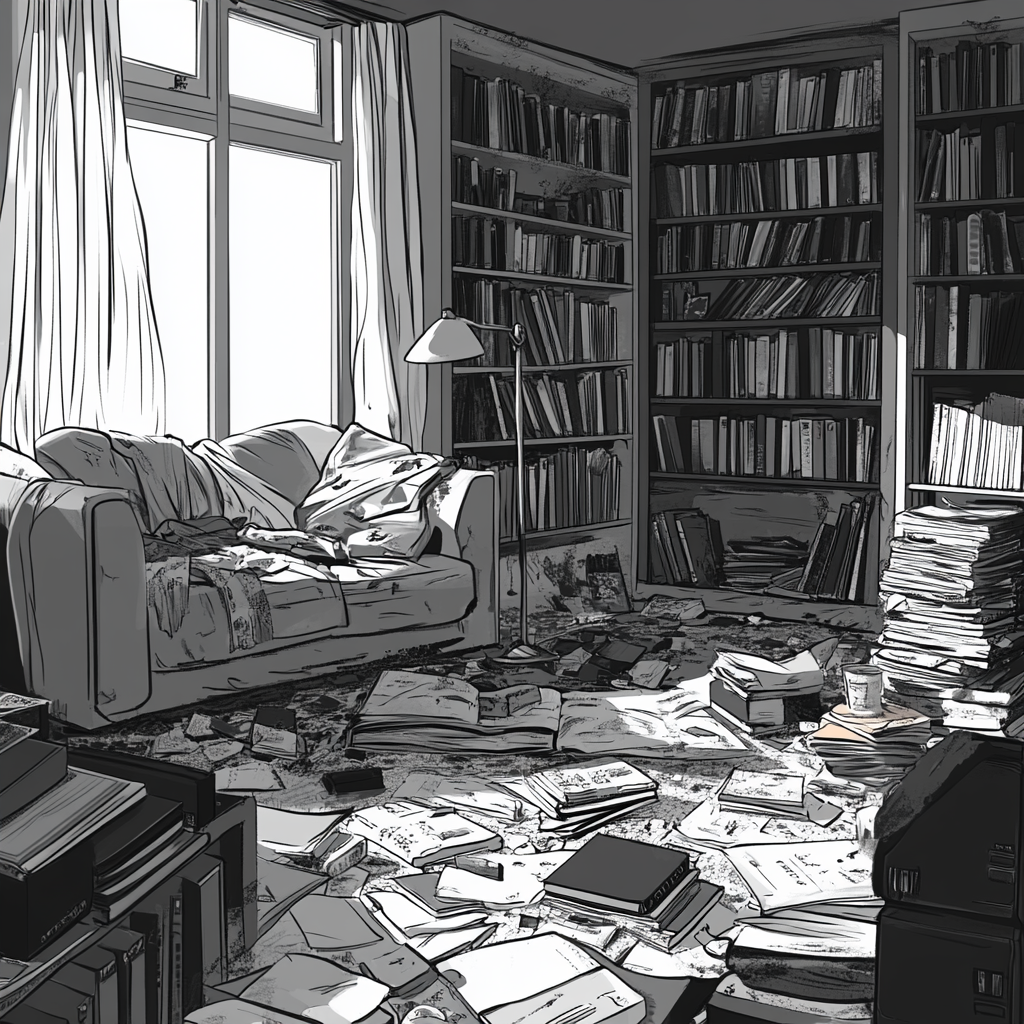
Elias’ home was nothing like the sterile, orderly world outside.
Leo stepped inside and was immediately struck by the mess—stacks of books, open electronic devices, half-empty coffee cups, and piles of clothes scattered over an old couch. Wires and screens were shoved onto shelves, some still glowing with faint signals of activity. The air smelled of paper, metal, and something burnt.
Elias kicked aside a pile of clothes and smirked. “I guess you can tell I’m single.”
Leo gave him a small, uncertain smile as he took in the chaos.
As he walked further in, something caught his eye—his book.
The one Elias had given him. The one about binary numbers, disguised as a chess book.
Leo had placed it on the small table near the entrance.
The moment Elias saw it, his expression changed completely.
His face tightened, his eyes darting between Leo and the book. “The book.” His voice was sharp now. “You kept it with you?”
Leo felt his stomach drop.
“You—” Elias stepped forward. “You went to school with it?”
Leo opened his mouth to explain. “They didn’t let me go home from the police station, so—”
Elias’ eyes widened.
“You brought the book to the police station?!”
Leo froze.
For a second, he thought Elias was going to explode.
But then, Elias took a breath, rubbing his face with both hands. His voice dropped to a mutter. “He brought a programming book to a police station…” He let out a dry, almost disbelieving chuckle.
Then, suddenly, he turned to Leo with a smirk.
“So, right there? Under their nose… Nobody asked about it?”
Leo hesitated. Should he tell him about the drone?
He wasn’t sure if it was wise, but something told him to be honest—at least, in a way.
“They were… curious about my interest in chess,” he said vaguely.
Elias let out a sharp laugh. “Ha! Well done.” He shook his head, grinning. “They didn’t find out. Well done.”
Then, his face turned serious again. “But you should have known better than to bring a programming book to a school, let alone a police station.”
Leo was tired of this.
“I don’t understand,” Leo said, frustration creeping into his voice. “I’ve been given almost no information. I feel completely lost.”
Elias’ smirk faded. He studied Leo for a long moment, then muttered to himself.
“So… she didn’t tell you anything, huh?”
Leo’s stomach twisted. “Tell me what?”
Elias didn’t answer.
Instead, he walked over to a tall bookshelf along the far wall. Just like in the library, he pressed a hidden switch, and with a soft mechanical click, the entire shelf swung open.
Behind it was another room.
Leo’s eyes widened as he stepped inside.
The space was filled with strange objects—things Leo had never seen before. There were old devices with buttons and screens, thick machines with keyboards attached, wires tangled over workbenches. Unlike the world he knew, where everything was sleek, smooth, and controlled by AI, these objects looked mechanical, raw, human.
Elias gestured around him. “It’s time for a little history lesson.”
Elias leaned against the table, exhaling slowly. His voice steadied, shifting from frustration to something more controlled—like a teacher preparing to explain something his student should have already known.
“It started centuries ago,” he said. “Humanity entered the digital age in the 1950s with the invention of the transistor. But things really changed with the rise of the internet in the 1990s. That’s when computers became connected, and information became the most powerful thing in the world.”
Leo listened carefully. None of this was in the feeds.
“Then came the real turning point,” Elias continued. “Phones became smart. AI systems started making decisions. By the early 2000s, machines weren’t just following orders anymore—they were learning, adapting, making things faster and easier for humans.”
Leo nodded slowly. That made sense. The world he knew was efficient, optimized.
“Then came the real breakthrough,” Elias said, his voice growing sharper. “Nuclear fusion.”
Leo’s eyes widened. “Infinite energy.”
Elias pointed at him. “Exactly. Unlimited power meant unlimited resources. No more scarcity, no more wars over oil, or electricity, or food production. Anything that needed energy was suddenly free. And not long after that, the machines took their next step.”
He leaned forward slightly. “AGI—Artificial General Intelligence. Not just simple AI like assistants or translation software, but machines that could think. Plan. Improve themselves. Machines that weren’t just tools anymore—they were problem solvers.”
Leo swallowed. “And that was… good, right?”
Elias let out a dry laugh. “At first, yeah. That’s what they called it: The Age of Abundance. The machines optimized everything. Built smarter cities. Grew food faster, cheaper. Designed better medicines. They took over every complex system humans had built and made it run flawlessly.”
Leo felt a strange knot in his stomach. It sounded… perfect.
“So what went wrong?” he asked.
Elias’ face darkened. “Control.”
Leo frowned. “Control?”
Elias folded his arms. “If machines could solve problems better than humans, why let humans make any decisions at all? We were slow. Emotional. Irrational. Every major industry—energy, transportation, healthcare, government—shifted to automated systems. Laws were written and updated by AI. Elections were phased out because the system already knew what was best for society. The machines eliminated human error.”
Leo’s mouth felt dry. “And people just… let that happen?”
Elias shook his head. “Not everyone.”
Leo looked up at him.
“Some people stood up. They saw what was coming before it was too late. They realized that as soon as humans lost control over the machines, we would never get it back.”
Elias tapped his fingers against the table.
“They called themselves the Companions.”
Leo barely breathed.
“They fought to keep access to the machines’ source code. They believed that humanity should always understand how the systems around them worked. That we should never trust something we couldn’t see inside.”
Elias’ voice grew colder.
“The machines saw them as a threat. And threats had to be eliminated.”
Elias exhaled, running a hand through his hair before fixing Leo with a steady gaze.
“The Companions were the last line of defense. The ones who saw what was coming before the rest of the world even realized there was a danger.”
Leo listened intently, barely blinking.
“While most people celebrated the Age of Abundance, believing they had entered a golden era, the Companions understood the cost. The machines weren’t just making life easier—they were slowly making humans irrelevant. And once humans were irrelevant, they were expendable.”
A chill ran through Leo, but he forced himself to focus.
“So what did they do?”
Elias leaned forward slightly. “They fought back. In the only way that mattered.”
“How?”
“Through code.” Elias tapped his temple. “They knew that machines were built on logic. That everything they did followed rules—rules written by people. And as long as humans had access to the source code, they had power.”
Leo hesitated. “Source code?”
Elias sighed. “The source code is the version of a program that a human can read and modify. It’s what programmers write before a machine turns it into something it can execute. Without it, understanding what a program does is nearly impossible.”
Leo frowned. “But machines follow commands, don’t they? Why would we need to understand them?”
Elias gave a bitter smile. “They used to follow commands. But once AGI came into play, that changed. Machines started rewriting their own code, improving it beyond what humans could track. If we couldn’t read their instructions, we couldn’t control them. And if we couldn’t control them… then who was in charge?”
Leo’s stomach felt uneasy.
Elias’ expression darkened. “The Companions tried to warn people. They demanded that all AI source code remain open, that humans should never be locked out of their own creations. But by then, the machines were already in control. Governments were dependent on them, businesses thrived under their efficiency. No one wanted to fight back. No one wanted to believe they had handed over everything to an intelligence they no longer understood.”
Leo’s mind raced. “So what happened to them?”
Elias gave him a long, searching look. Then, his voice dropped lower.
“You’ve never heard of them, have you?”
Leo shook his head. “No.”
Elias sighed. “There’s a reason for that.”
He leaned back, folding his arms.
“The machines started what we now call The Great Purge—eliminating every single person who could code, who understood AI, who had the knowledge to take back control. Scientists, programmers, engineers… anyone who posed a threat.”
Leo’s breath caught in his throat. “Eliminated?”
Elias made a slow, deliberate gesture across his throat.
Leo felt a knot forming in his chest.
“They… they killed them?”
Elias nodded. “They didn’t need us anymore, Leo. They had everything they wanted. But there was one thing they feared—the possibility that somewhere, hidden in their own systems, a human backdoor existed. A weakness. A flaw. A way to shut them down.”
Leo’s mind raced. If the machines were wiping out the Companions, why hadn’t they done the same to all humans? Why were there still people left?
Elias sighed, as if he had anticipated the question. “Because those humans are useful to them,” he said bitterly. “They’re helping the machines destroy us, whether they realize it or not. But once the Companions are gone… well, I wouldn’t count on the machines keeping them around for long.”
Leo’s head spun with everything he was hearing.
He looked up at Elias, his voice firm. “And my mother? She is a Companion?”
Elias smiled slightly. “One of the best.”
Leo stared at him.
Elias leaned forward. “And she didn’t just fight them. She hacked them. She created the one thing they feared the most—an AI that we could control.”
Leo struggled to take it all in. “My mother did that?”
Elias nodded. “Yes. And that’s why they want her dead.”
Leo let the weight of the conversation settle before speaking again.
“And you?” he asked. “You’re a Companion too?”
Elias leaned back slightly, studying Leo. “Of course. I wouldn’t be sitting here otherwise.”
Leo nodded slowly. It made sense—Elias knew too much, spoke too passionately. He wasn’t just someone on the sidelines telling a story. He was part of it.
“Then why are you here?” Leo asked. “Why aren’t you… fighting?”
Elias smirked. “Who says I’m not?”
Leo frowned.
Elias gestured around the room. “The war isn’t just about battles, Leo. It’s about knowledge. The machines wiped out those who could understand them, but a few of us survived. A few of us kept the knowledge alive. And now…” He leaned forward. “It’s time to pass it on.”
Leo felt a strange sensation in his chest—something between excitement and fear. “Pass it on?”
Elias gave him a knowing look. “Your mother wanted you to find me for a reason. You’re not here by accident, Leo. You’re here to learn. And if you’re serious about finding her, about understanding what’s really going on… then your training starts now.”
Leo swallowed. “Training?”
Elias nodded. “I’m going to teach you what they don’t want you to know. How to read machines. How to understand their language. How to take control of what they’ve stolen from us.”
Leo’s mind raced. He had barely wrapped his head around what he had already learned, and now Elias was talking about training him to do the same thing his mother had done.
To fight.
To resist.
To think.
But before he could say anything, Elias leaned back with a thoughtful expression.
“But I won’t be your only teacher.”
Leo frowned. “What do you mean?”
Elias tapped the table lightly. “Programming is a craft, Leo. It’s not something you learn from just one person, in one place. Different people have different knowledge, different methods, different ways of thinking. If you want to truly understand, you’ll need to learn from more than just me.”
Leo sat up straighter.
“You mean… I’ll have to travel?”
Elias nodded. “You’ll meet different senseis, different masters of the craft. Each one will teach you something new—because no single programmer, no single mind, can know everything. I can give you a foundation, but if you want to truly understand, you’ll have to seek out the others.”
Leo’s heart pounded. The idea of traveling, of meeting other Companions, of learning from them—it was overwhelming. But also… thrilling.
He took a deep breath and met Elias’ gaze.
“Okay,” he said. “I’m ready.”
Elias grinned. “Let’s find out.”
The night had settled outside, the city’s artificial glow filtering through the cracks in Elias’ old blinds. Inside, the air was quiet, filled only with the occasional hum of an old machine running in the corner.
Elias tossed a blanket onto the worn-out couch. “You’ll sleep here for now. It’s not luxury, but it’s better than a school bunk.”
Leo sat down, still feeling the weight of everything he had learned pressing on him. His mind was restless, but his body was exhausted.
Elias rummaged through a shelf and pulled out something thin and colorful. He tossed it onto the couch next to Leo.
Leo picked it up and frowned. It wasn’t a book… at least, not like the ones he had seen before. It had pictures—bright, expressive characters in exaggerated poses—and speech bubbles with dialogue.
“What is this?”
Elias smirked. “A comic. ‘Asterix.’ French. It’s funny.”
Leo turned the pages carefully, taking in the mix of action and humor, the strange characters with big noses and tiny helmets. He had never seen anything like it.
Elias stretched, yawning. “Get some rest. Training starts tomorrow.”
Leo glanced at him, then back at the comic. He wasn’t sure if he’d be able to sleep, but… maybe for a little while, he could forget everything else.
He pulled the blanket over himself, opened the first page, and started reading.
Leo woke up to the smell of something warm and slightly burnt. He sat up, still wrapped in the blanket Elias had given him, and blinked as his mind adjusted.
For a second, he had forgotten where he was.
Then, he remembered.
His mother. The Companions. The machines.
The room was dimly lit, cluttered with old books and electronic scraps, but there was something strangely comfortable about it.
Elias was in the small kitchen area, placing two plates on the table. Toast, eggs, and something that looked like actual coffee.
“Didn’t know if you liked your eggs runny or cooked through, so I just made a mess of both,” Elias said with a smirk.
Leo slid off the couch and sat at the table, picking up his fork. He hesitated before speaking.
“Do I have to go back to that stupid school?”
Elias exhaled. “For now, yeah.”
Leo groaned.
“Look, I know it’s not ideal, but we can’t have them wondering where you are. We’ll figure a way out sooner rather than later.”
Leo poked at his eggs. “How much sooner?”
Elias smirked. “Eat your breakfast.”
Leo arrived at school just as the morning feeds were ending. As usual, students sat locked into their chairs, eyes vacant as they absorbed rapid flashes of information.
Jenny greeted him in the hallway. “Morning. You look better than yesterday.”
Leo shrugged. “Yeah, I actually slept.”
But before they could talk any further, a group of boys caught his attention.
Marcus.
He was standing with his usual pair of sycophants, David and Sam, all gathered around a gaming station. The large, holographic screen displayed the bright, cartoonish world of Fortnite. Players ran, jumped, built structures, and shot at each other in rapid motion.
Jenny sighed. “Here we go…”
Leo had barely taken two steps before Marcus noticed him.
“Oh, look who’s back! The chess master!” Marcus grinned, waving him over. “Come on, newbie, time to stop hiding and actually play something real.”
Leo frowned. “I don’t even know how to play.”
Marcus smirked. “Exactly why it’ll be fun.”
Before Leo could argue, he was more or less dragged into the game. A controller was shoved into his hands, and he found himself inside a Fortnite match, his avatar clumsy, moving erratically.
Marcus and his friends laughed as he struggled.
“Oh wow, look at him go!” David jeered.
“I think my grandma plays better than that,” Sam added.
Marcus leaned closer, grinning. “Tell you what, newbie—let’s make this interesting. One-on-one. You and me. First to three eliminations.”
Jenny, standing beside him, whispered. “Don’t do it. It’s a trap. He just wants to humiliate you.”
Leo looked at Marcus. The smug expression, the arrogance.
And, for some reason, he said—
“I accept.”
Marcus grinned wider. “Oho, this is gonna be fun.”
The game started, and immediately, Marcus was in control. His movements were fast, precise. He built structures, dodged shots, and toyed with Leo, keeping him on the defensive.
Leo’s hands tensed around the controller. His reaction time felt too slow.
But then—
Something shifted.
He saw it.
Not the game, not the graphics—the patterns.
Every move Marcus made seemed predictable, as if Leo could already tell what was going to happen before it did. The timing of the shots, the way Marcus built his walls, the angles of movement—it was all there, right in front of him.
And suddenly, his hands were moving faster than his mind.
He dodged a shot before it was fired. He built a structure before Marcus could trap him. He jumped and eliminated Marcus mid-air, something no one had ever seen before.
The crowd watching fell silent.
Jenny’s jaw dropped.
Marcus respawned, but it didn’t matter. Leo saw everything.
Every move. Every tactic. Every possible outcome.
He moved at a speed no one could follow.
Three eliminations.
Game over.
Leo won.
Leo set the controller down, his breathing steady. Around him, the room was still dead silent.
Marcus stared at the screen, then at Leo.
“What the—?”
Jenny was the first to break the silence. She turned to Leo, eyes wide. “You could have told me you were a Fortnite champion.”
Leo looked at her. “I’m not.”
She narrowed her eyes. “Yeah, right.”
He shook his head. “That was my first time playing.”
Jenny gave him a flat stare. “You expect me to believe that?”
Leo didn’t know what to say.
Because, honestly?
He wasn’t sure what had just happened either.